What Septic Tank Locating Does When Your Property Has No Records
Suppose you just bought a rental in Hesperia, the tank has never been pumped on your watch, and nobody left you a map. Before any crew can pump, inspect, or repair that system, someone has to find it. That is what septic tank locating does: it pins down exactly where your buried tank and its lid sit, so the rest of the work can happen without digging up half the yard. For High Desert properties with septic tank no records, it is often the first job, not an extra.
This matters more than most new owners expect. More than one in five U.S. households depend on individual septic systems or small community cluster systems to treat their wastewater, according to the U.S. Environmental Protection Agency. In Hesperia and the surrounding High Desert, that share runs higher, and many of those systems went in decades ago with paperwork that never followed the property through each sale.
Here is a step-by-step guide to how a locate actually works, what you can do yourself first, and where a professional earns their fee.
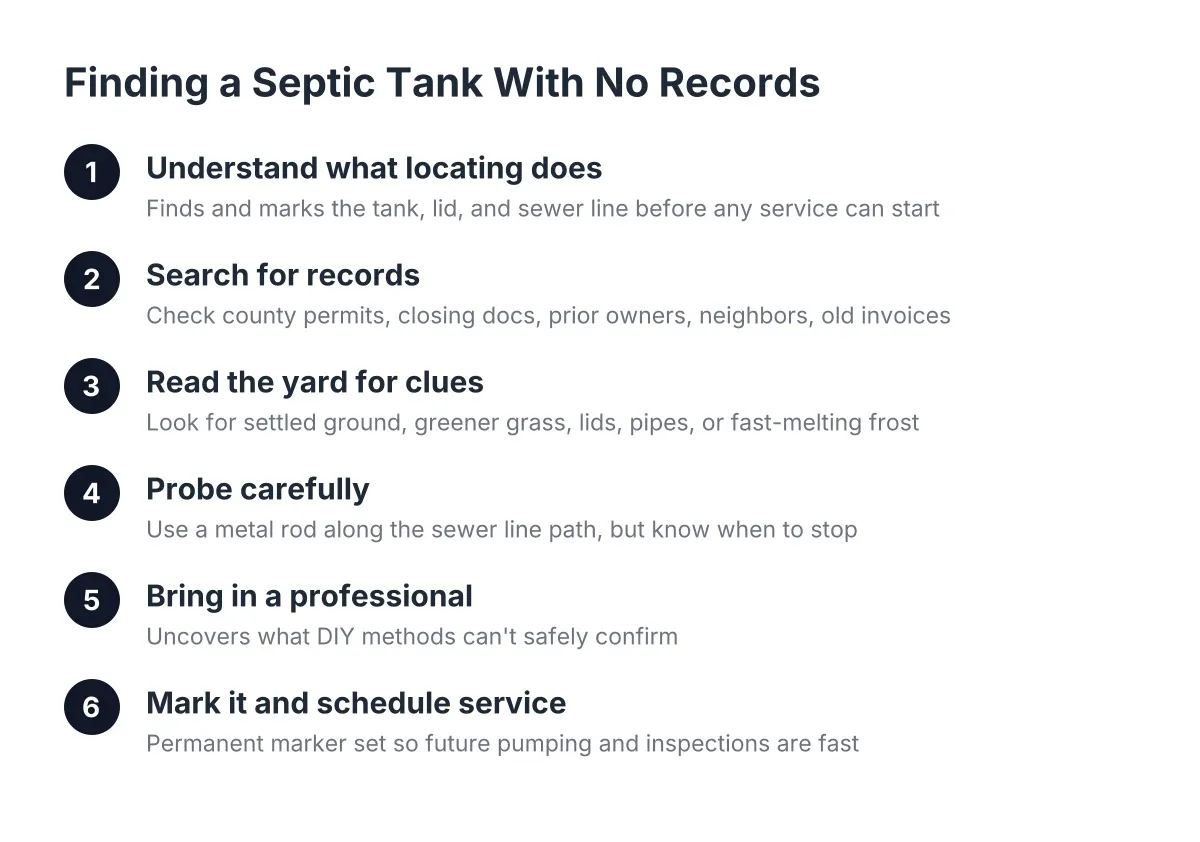
Step 1: Understand What Septic Tank Locating Does and Why It Comes First
Septic tank locating is the process of finding and marking a buried septic tank, its lid, and often its main sewer line when the location is unknown. A crew traces the line from the house, confirms the tank position, and marks the lid so it can be exposed for pumping, inspection, or repair.
Why does this come before everything else? A pumping truck cannot pump what it cannot reach. An inspector cannot inspect a lid nobody can find. A remodel or addition cannot get approved if the county does not know where the system sits. Locating is the key that unlocks all of it.
For a small landlord, the timing usually looks like one of these:
- A tenant reports slow drains or a sewage smell, and you realize you have no idea where the tank is.
- You are turning over a unit between leases and want the tank pumped before the next tenant moves in.
- You are buying land or a house with a septic system and the seller has no records.
- You are planning a remodel, a driveway, or a new structure and need the tank marked so nothing gets built over it.
In each case, the locate is a one-time cost that pays off every time the system needs service afterward. Once the tank is found and marked, every future septic tank pumping visit gets faster and cheaper.
Step 2: Searching for Records When You Have No Septic Tank Documentation
Start with paper, not a shovel. San Bernardino County may have a permit or an as-built diagram on file showing where the tank was installed. Ask the county's environmental health or building department for any septic permit records tied to the parcel number.
Next, work through these sources:
- The seller's disclosure packet or your closing documents, which sometimes include a septic inspection from the sale.
- The previous owner or their realtor, who may remember where the last pumping crew dug.
- Neighbors with similar-age homes, since tract-built houses in the same era often placed tanks in the same relative spot.
- Any old invoices from a septic company left in a kitchen drawer or garage, which sometimes sketch the tank location on the receipt.
However, be ready for dead ends. Many High Desert homes were built before consistent record-keeping, and rural parcels changed hands with no paperwork at all. Situations where you find a septic tank with no records are common here, not a red flag about your property. If the paper trail runs out, move to the physical clues.
Step 3: Read the Yard for Physical Clues
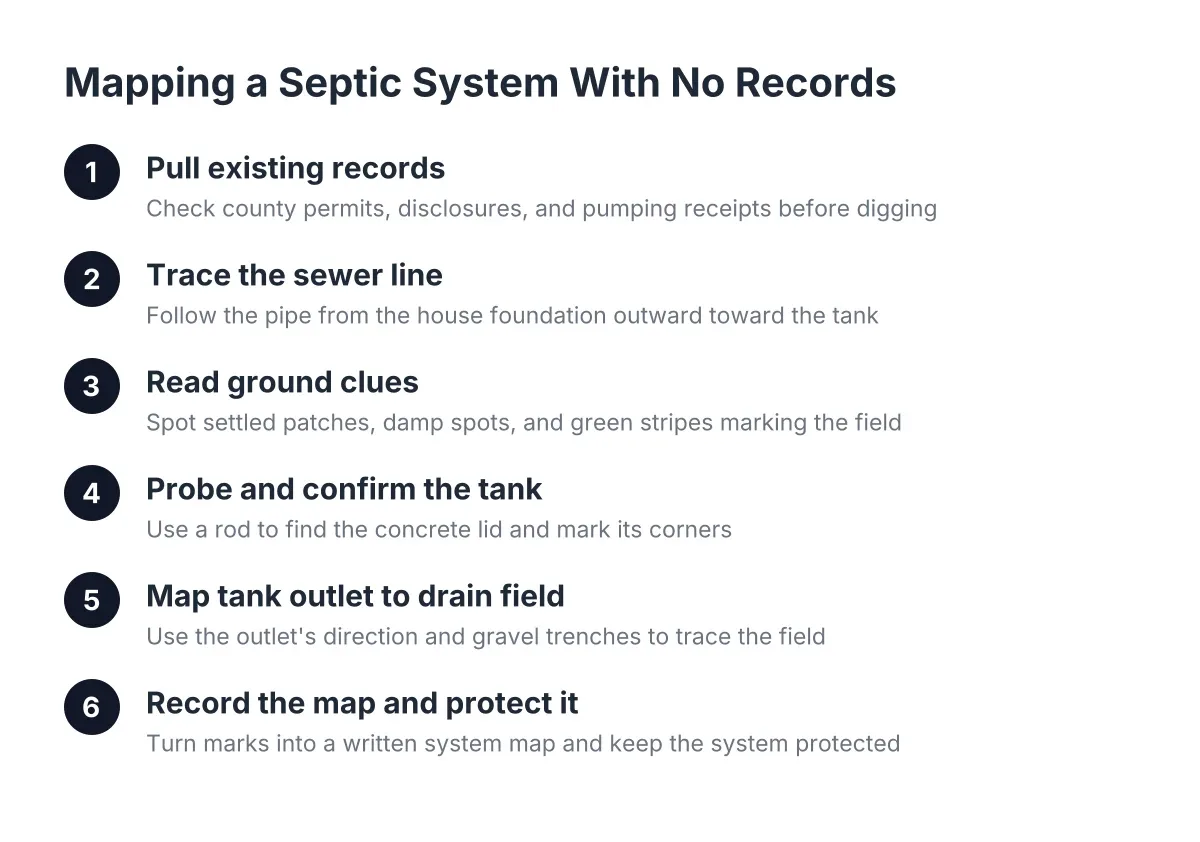
Your yard often tells you where the tank sits, if you know what to look for. Walk the property, especially the area between the house and the property line on the side where the main bathroom plumbing exits.
Look for these signs:
- A rectangular patch of ground that settles lower or sits higher than the surrounding dirt.
- Grass or weeds that grow greener or faster in one spot, even in dry High Desert conditions.
- A concrete lid, a metal cap, or a white PVC pipe sticking a few inches out of the ground; that pipe may be a cleanout or an inspection port.
- Snow or frost that melts faster over one area in winter, since tank contents run warmer than soil.
In addition, check inside the house. Find where the main sewer line leaves the foundation, usually below the lowest bathroom or in the crawl space. The tank typically sits along that line's path, often within 10 to 25 feet of the house, though older rural installs can break that rule.
Mark anything promising with a flag or a rock. Even a rough guess saves a professional crew time, and time is what you pay for.
Step 4: Probe Carefully, and Know When to Stop
If the clues point somewhere specific, you can probe by hand. Use a thin metal rod, push it into the soil at an angle, and feel for the hard, flat resistance of a concrete or fiberglass tank top. Work in a grid pattern along the suspected sewer line path.
Stop probing if any of these apply:
- The soil is soft, wet, or smells like sewage, which can mean a failing lid or a saturated area you should not stand on.
- You hit anything that feels like pipe rather than tank; older clay and Orangeburg lines crack under a probe.
- The tank might be steel, common in older installs, since a rusted steel lid can collapse under a person's weight.
That last point is the honest limitation of every do-it-yourself method. An aging tank lid is a genuine safety hazard, and gases inside a tank can be fatal. If you have any doubt about the tank's age or material, or if probing turns up nothing after an hour, hand the job to a professional. This is one of the places where paying for expertise beats guessing.
Step 5: What Professional Septic Tank Locating Uncovers
A professional locate uses tools and pattern knowledge that a homeowner with a probe rod does not have. A typical crew flushes a small transmitter down a toilet, then follows its radio signal above ground with a receiver. The signal stops moving where the line enters the tank, which pins the location within inches. Crews may also use electronic line tracers or probe with experience behind every push.
What professional septic tank locating does beyond finding the tank is the part most owners undervalue. A good locate visit should leave you with:
- The tank position and lid marked, and usually the lid exposed for immediate pumping if you schedule both together.
- A sense of the tank's orientation, since many tanks have separate access points over the inlet and outlet.
- Notes on where the drain field likely runs, so you never park, build, or plant over it.
- A record you can keep in your property file, which matters when you own two, three, or five septic-served rentals and cannot memorize every yard.
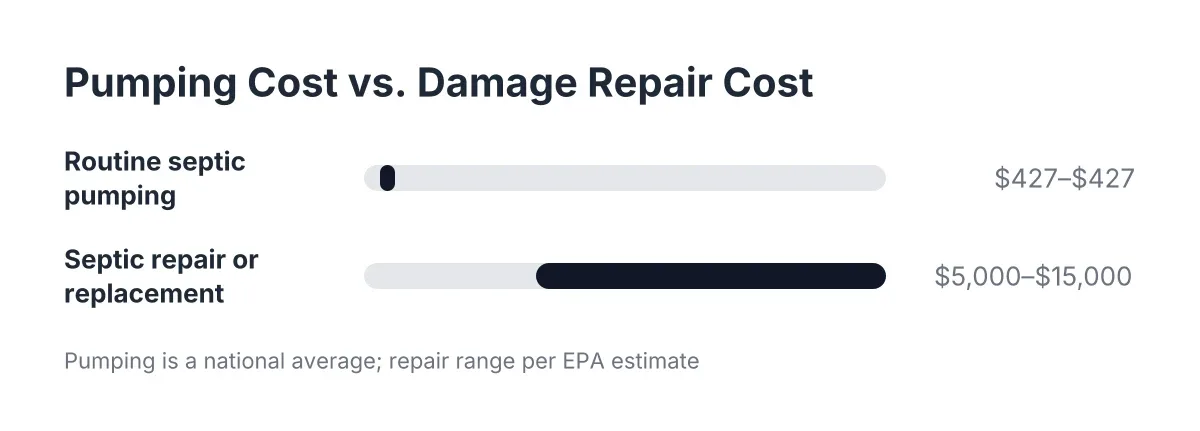
For example, say a landlord owns a 1970s rental off Ranchero Road with a septic tank no records situation. In that hypothetical, a locate plus pumping in one visit might run a few hundred dollars total as a rough estimate, and the marked lid location cuts every future service visit down because nobody hunts for the tank again. Compare that with the alternative: pumping alone averages $427 according to Angi data, while the EPA estimates septic repair or replacement typically costs $5,000 to $15,000. Finding the tank so it can be maintained is the cheap end of that spectrum by a wide margin.
Step 6: Mark It Permanently and Put the System on a Schedule
Once the tank is found, never lose it again. Take photos with measurements from two fixed points, like a house corner and a fence post. Sketch the location and keep it with the property's records. Some owners set a flat paver or a discreet marker over the lid; others install a riser that brings the lid access to ground level so no digging is ever needed again.
Therefore, the locate should flow straight into a maintenance plan. The EPA recommends a professional inspection at least once every three years for the average household, and once a year for systems with pumps, float switches, or other mechanical parts. For a rental, tie the inspection to something you already do, like lease renewal or an annual property walkthrough.
As of 2026, there is no shortcut around this for High Desert properties with missing records. But the good news is that septic tank locating is a one-time problem. Solve it once, document it, and your septic system goes from a mystery under the dirt to a line item you manage on your own schedule, before a tenant ever calls about a backup.
If you need your septic tank serviced, Hesperia Septic can help.