Septic Tank Locating vs. Drain Field: How to Map a System With No Records
Buying High Desert land with no septic records means you own two mysteries, not one. There is a buried tank somewhere, and there is a drain field somewhere else, and neither shows up on the paperwork the seller handed you. This guide walks through septic tank locating, drain field mapping, and the process of mapping septic systems to help you piece together the full system layout step by step, so you know exactly what is in the ground before you close escrow or break ground on a remodel.
First, a quick frame. According to the U.S. Environmental Protection Agency, a conventional septic system has two main components: the septic tank and the drain field. The tank is where solids settle and get pumped out. The drain field is a network of perforated pipes laid over gravel and buried in soil, where the clarified liquid soaks away. Finding one without finding the other leaves your map half done, and around Hesperia, where lots are large and old installs went undocumented, half a map can cost you.
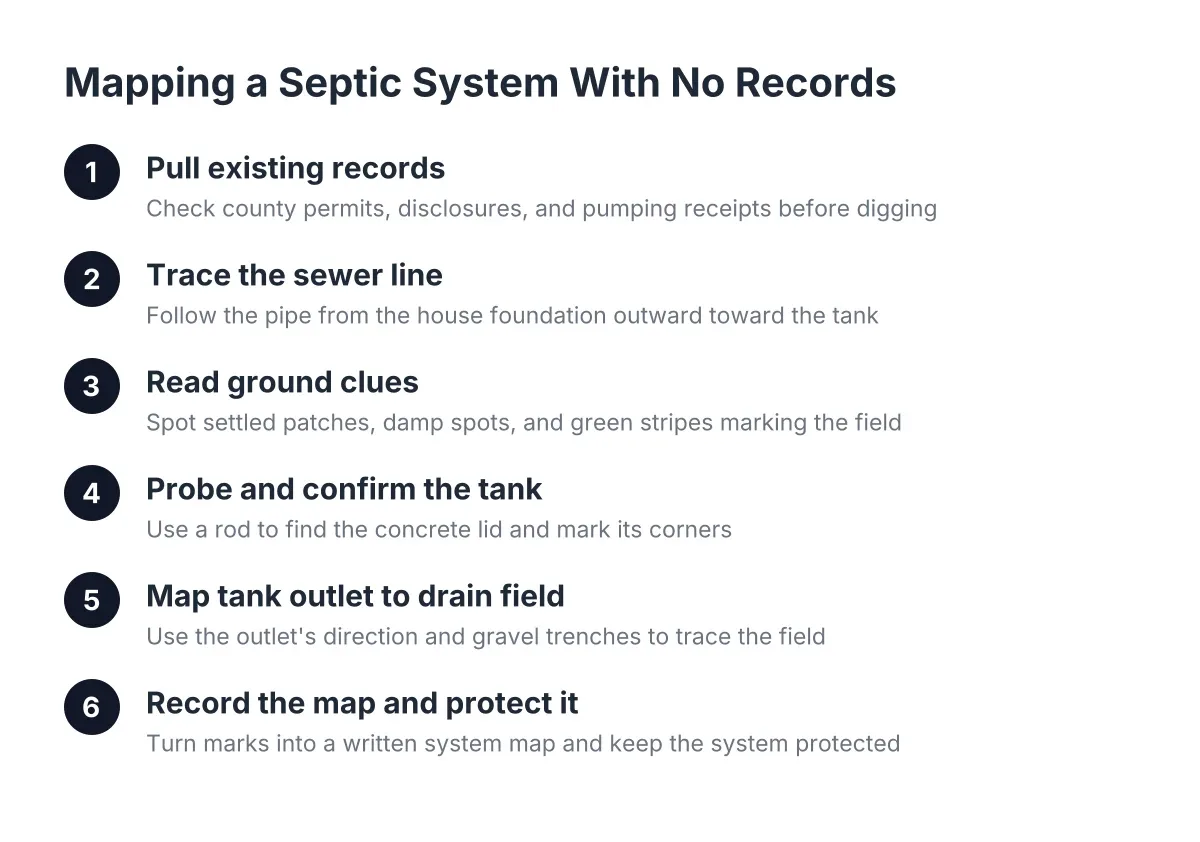
Step 1: Pull Whatever Records Exist Before Anyone Digs
Start at the desk, not in the dirt. Even properties with "no records" often have a partial paper trail, and any scrap narrows the search area.
Check these sources in order:
- San Bernardino County records. Ask for the septic permit or as-built drawing tied to the parcel. Older Hesperia properties may have nothing on file, but it costs you a phone call to find out.
- The seller's disclosure and past pumping receipts. A pumping invoice from any prior owner usually notes tank access and sometimes a sketch.
- The original builder or a neighbor with a similar-era home. Tract-built homes in the same area often placed tanks in a consistent spot relative to the house.
An as-built drawing typically shows the tank's distance from the foundation. Even a rough sketch turns a whole-yard search into a ten-foot circle. If the county has nothing, note that too; a lender or permit office may require a professional inspection anyway, and you will want to know that before escrow deadlines tighten.
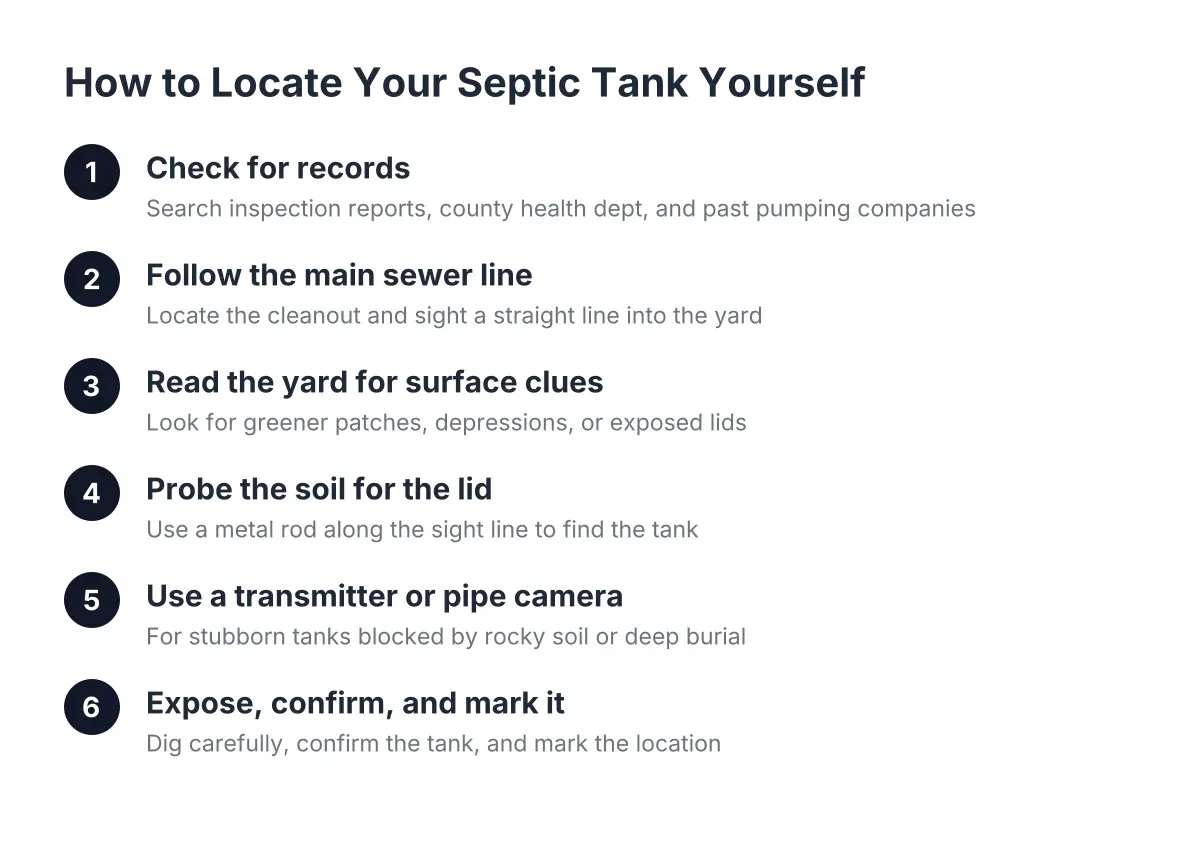
Step 2: Trace the Sewer Line From the House Outward
Every septic system starts at one pipe. A single sewer line collects all household drains and carries them to the tank, according to the US EPA. Find where that pipe exits the house, and you have your starting direction.
Go into the crawlspace or look along the foundation for the main sewer line, usually a 3 to 4 inch pipe heading away from the building. Outside, look for a cleanout, a capped pipe sticking up near the foundation. The tank almost always sits along the straight line the pipe points toward.
However, do not stop searching close to the house. Tanks are set some distance out from the foundation, not tucked against it, so extend your search line well into the yard. On a typical Hesperia lot, that line can run a surprising distance before it hits the tank.
Step 3: Read the Ground for Tank and Drain Field Clues
Next, walk the property slowly and look for what the soil is telling you. High Desert ground gives away buried systems in a few ways:
- A rectangular patch where the dirt settled slightly, or where weeds grow differently than the surrounding scrub
- A low mound or a spot that stays damp when everything else is bone dry
- Parallel green stripes in an otherwise brown yard, which often mark drain field lines fed by moisture below
- Old concrete fragments, riser rings, or a lid edge barely showing at grade
Those parallel stripes matter for mapping. When you can see multiple drain field lines, the tank generally sits at the point farthest from the field, since solids settle in the tank before liquid flows out to the pipes. Sketch what you see on paper with rough distances from the house. You are building the site map the previous owner never made.
Step 4: Probe and Confirm the Tank Location
Once the clues point to an area, confirm it by feel. Use a metal probe rod or a thin fiberglass rod, and push it into the soil every couple of feet along your suspected line. Soil over a tank gives way, then stops hard at the concrete lid, usually within a foot or two of the surface on older installs, though depth varies.
Probe gently at an angle so you do not punch through a deteriorated lid or crack an inlet pipe. Old concrete lids on undocumented systems can be brittle. When the rod hits flat resistance in a rectangular pattern, you have found the tank. Mark the corners with flags or spray paint.
If probing turns up nothing, this is the point where professional septic tank locating earns its fee. A crew can run a camera with a transmitter down the sewer line and trace the pipe electronically to the tank, then find the lid without trenching the whole yard. That service costs more than a probe rod, but it beats guessing with a backhoe.
Step 5: Mapping Your Septic System From Tank Outlet to Drain Field
Finding the tank is half the job. Now use the tank itself to find where the water goes. Locating the drain from the septic tank, meaning the outlet side, tells you which direction the drain field runs.
Open the tank access once it is exposed, or have a professional do it, and identify the inlet and outlet. According to the University of Nebraska-Lincoln Extension, the outlet pipe sits lower than the inlet, since only liquid should leave toward the drain field. The outlet's direction is your drain field bearing.
From there, the field usually fans out in parallel trenches. The US EPA describes the construction: a thick gravel layer, perforated pipes on top, more gravel, then soil over the whole assembly. Probing along the outlet bearing every few feet will find those gravel trenches; the rod drops through loose gravel instead of hitting undisturbed hardpan. Flag each line you find and add it to your sketch.
Step 6: Turn Marks Into a Written System Map and Inspection
Flags in the yard help the pumping crew. Paper helps you at closing. Convert your findings into a simple site map: tank corners and lid location with distances from two fixed points on the house, outlet direction, and each drain field line.
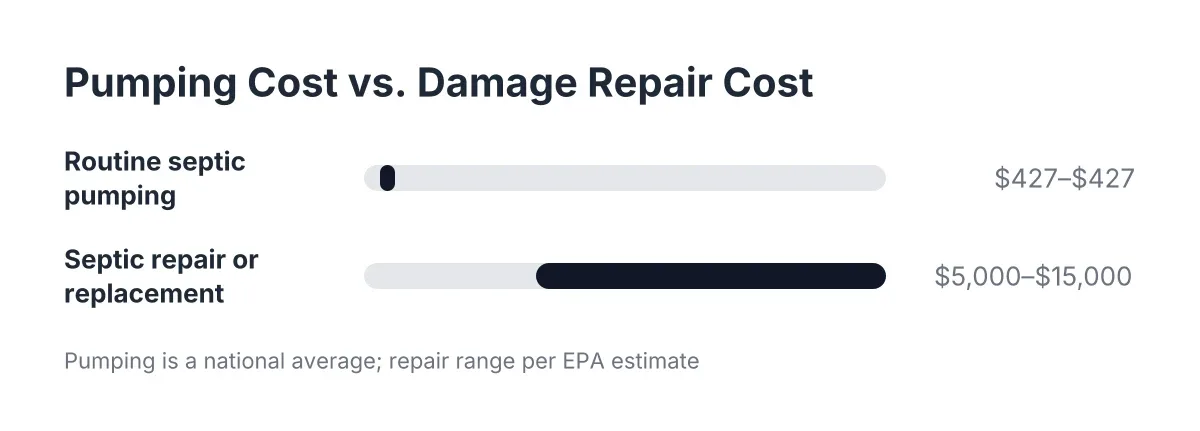
For a purchase decision, pair the locate with a septic system inspection. An inspector can open the tank, check liquid levels and baffles, and give you a written report you can hand to a lender, the county, or your agent. The EPA recommends a professional inspection at least every three years for the average household, and a purchase is the natural moment to start that clock. If the system turns out to be failing, you want that leverage before closing, not after; the EPA estimates septic repair or replacement typically runs $5,000 to $15,000, far more than routine septic tank pumping.
For example, suppose a buyer is in escrow on a 1970s Hesperia property with no county file and no visible lid. In that scenario, a typical sequence is a records check, a sewer line trace, a locate and mark on the tank, then an inspection with pumping so the inspector can see the empty tank. The whole thing usually fits inside a standard inspection contingency window, so the locate itself rarely delays the sale.
Step 7: Protect the System You Just Mapped
Finally, put your new map to work. Mark or install risers so the lid stays findable for the next pumping, and keep the map with your property records.
Keep vehicles off both the tank and the drain field; repeated driving over either can crush pipes or collapse a lid. In addition, plan any future structure around the system, not the other way around. If a garage, shop, or pool would sit over the drain field, moving the planned structure is almost always cheaper than moving the septic system. Keep drainage ditches and any standing water directed away from the field so it does not flood.
When Septic Tank Locating and Drain Field Mapping Need a Pro
Some situations outgrow the probe rod. Call a professional locate crew when the sewer line takes turns you cannot trace, when the lot is large and the clues are absent, when the tank sits deeper than a hand probe reaches, or when a lender or the county requires documented results. Commercial properties with grease traps or holding tanks, like a restaurant or an RV park changing hands, have the same problem with higher stakes; an undocumented grease trap still has to be found before it can be pumped on a compliance schedule.
There is a real trade-off to weigh. Paying for a professional locate and inspection on a property you might not buy feels like sunk cost. Against that, weigh what you are protecting: even routine septic tank pumping averages $427 according to Angi, and a hidden failing system can swing a purchase by five figures. On raw or older High Desert land with zero records, a documented locate and mark is usually the cheapest certainty available. And if there is any chance the system was abandoned, altered, or built without a permit, get a professional involved before you dig; an old tank with a compromised lid is a genuine safety hazard.
Map the tank, map the drain field, put both on paper. That is the whole job, and once it is done, every future pumping, permit, and remodel on that property gets easier.
If you need your septic tank serviced, Hesperia Septic can help.
Prefer to talk it through? Call (760) 249-7872 — a quick call is usually the fastest way to get a straight answer for your situation.