Grease Trap Pumping Mistakes That Lead to Clogs, Failed Inspections, and Big Repair Bills
If you run a restaurant or commercial kitchen in Hesperia, CA, grease trap pumping is one of those jobs that only gets attention when something goes wrong. A trap that has not been pumped on schedule does not announce itself politely. It backs up a floor drain during the Friday dinner rush, or it costs you points on a health inspection because you cannot produce a pumping record. Most of those failures trace back to a handful of avoidable mistakes, and this guide walks through each one, what it costs you, and how a compliance-focused service keeps you out of trouble.
This matters whether you are running an established kitchen or you just bought a property and have no records at all. Maybe you took over a building with a grease trap you have never opened, or you are closing on a commercial property and the seller cannot tell you when the trap was last serviced. Either way, the mistakes below are the ones that turn a routine maintenance item into an expensive problem.
Why Grease Is a Bigger Problem Than Most Owners Think
Grease does not behave like other waste. When hot fats, oils, and grease go down a drain, they cool, harden, and stick to the inside walls of the pipe. A paper clog can be punched through with a snake and the line runs clear again. A grease clog is different. Even after a cable opens a hole through it, the grease coating stays on the pipe walls and catches new grease, so the line re-clogs. That is why prevention through regular pumping beats emergency clearing every time.
The scale of the problem is bigger than most people assume. A single restaurant can release between 800 and 17,000 pounds of grease into the sewer system each year, according to Wastewater Digest. And grease from restaurants, homes, and industrial sources is the most common cause of reported sewer blockages, responsible for 47 percent of cases, according to the U.S. Environmental Protection Agency. Those numbers are why health departments and sewer authorities take grease trap compliance seriously, and why your trap is a standing item on inspections.
A grease trap works by slowing wastewater down so the grease can separate. Fats, oils, and grease float to the top as a scum layer, food solids sink to the bottom as sludge, and the liquid in the middle flows out. The same layering happens inside a septic tank, where grease and scum float on top and sludge settles to the bottom, according to the U.S. Environmental Protection Agency. The trap only has so much room for those layers. Once they grow too thick, grease starts passing straight through to your sewer line or septic system. Everything that follows comes down to managing those layers before they win.
Mistake 1: Waiting for a Backup Instead of Pumping on a Schedule
The single most expensive habit in grease trap management is treating pumping as a reaction instead of a routine. A trap that gets pumped on schedule costs you a predictable service visit. A trap that gets pumped only when drains slow down costs you emergency rates, lost service hours, and sometimes a plumbing repair on top of the pump-out.
Here is a hypothetical that plays out in kitchens everywhere. Say a taco shop owner in Hesperia skips two scheduled pump-outs to save money during a slow quarter. The trap fills past capacity, grease escapes into the lateral line, and three months later the kitchen floor drain backs up on a Saturday. Now the owner pays for emergency pumping, a line jetting to clear the hardened grease, and a day of lost sales while the kitchen is shut down. The two skipped services saved a few hundred dollars. The backup cost several times that, and in that scenario the health department may also get involved if sewage reached food prep areas.
The fix is boring and effective: put pumping on a calendar and keep it there. How often depends on your trap size and your volume of fried and greasy food, so the honest answer varies by kitchen. A common industry rule of thumb is to pump when the combined grease and solids reach about a quarter of the trap's depth. A good grease trap pumping service will check your levels on each visit and help you dial in the right interval instead of guessing.
Mistake 2: Skimming the Top and Calling It Serviced
Some operators, and some low-cost services, only skim the floating grease layer off the top and leave the sludge on the bottom. The trap looks better. It is not actually serviced. The solids at the bottom keep reducing the trap's working capacity, and the trap fills back to a failing condition faster each cycle.
A full pump-out removes everything: the scum layer, the liquid, and the sludge at the bottom. The walls and baffles get scraped down so hardened grease does not break loose later and clog the outlet. Then the trap is inspected for damaged baffles, corrosion, and inlet or outlet problems before it goes back into service. If you are comparing quotes, this is the first question to ask: full evacuation or skim only. A skim-only price that looks cheap is cheap because it leaves half the job in the tank.
What a Complete Grease Trap Pumping Visit Should Include
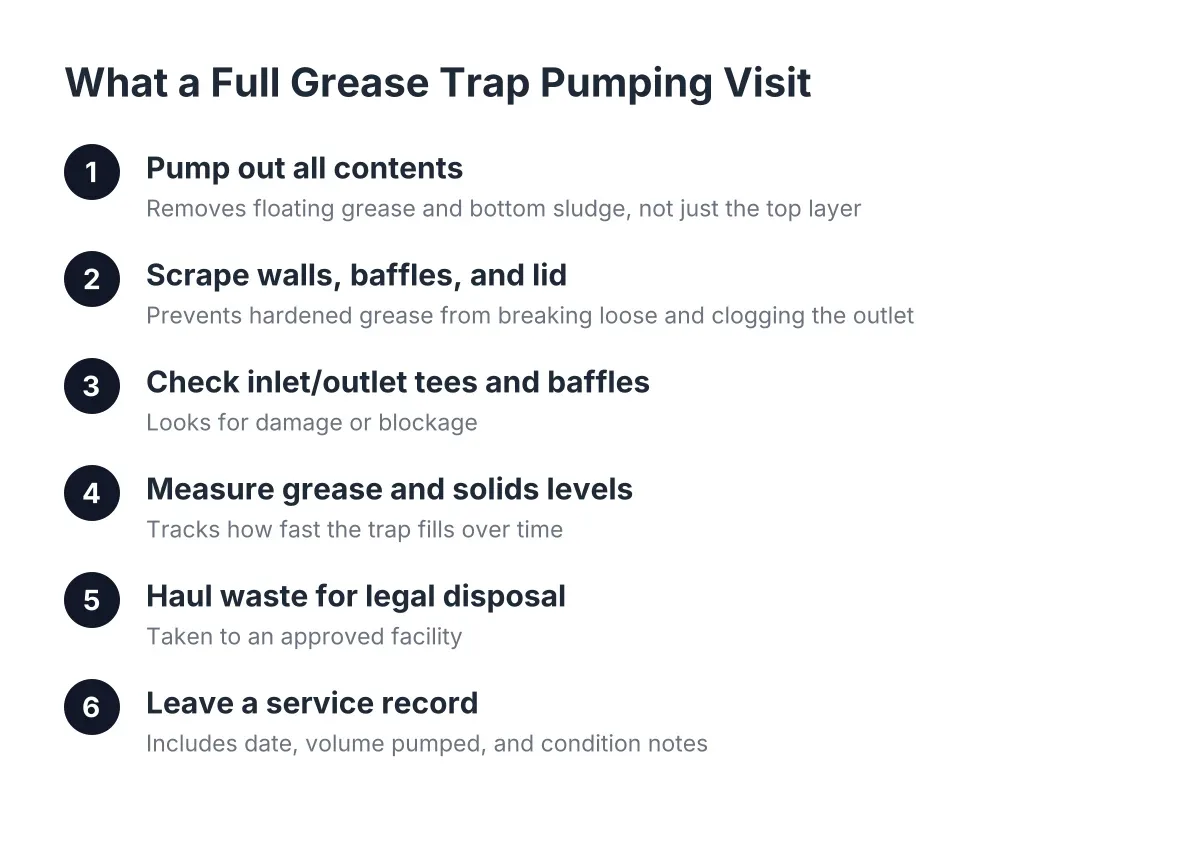
A proper service visit is more than a truck and a hose. At minimum, expect the crew to:
- Pump out all contents of the trap, including the bottom sludge layer, not just the floating grease
- Scrape grease buildup off the walls, baffles, and lid
- Check the inlet and outlet tees and the baffles for damage or blockage
- Measure and note the grease and solids levels so you can track how fast your trap fills
- Haul the waste away for legal disposal at an approved facility
- Leave you a service record with the date, volume pumped, and condition notes
That last item matters more than most owners realize, which brings us to the next mistake.
Mistake 3: No Paper Trail When the Health Inspector Asks
Pumping the trap is only half of compliance. Proving you pumped it is the other half. Health inspectors and sewer authorities commonly ask for service records, and in many jurisdictions commercial kitchens are required to keep a maintenance log showing when the trap was pumped, by whom, and how much was removed. An owner who serviced the trap last month but cannot produce a receipt is in nearly the same position as an owner who never serviced it at all.
Therefore, treat documentation as part of the service, not an afterthought. Every pump-out should generate a dated record you can file and hand over on demand. If your current provider does not leave paperwork, that is a reason to switch providers, not a quirk to live with. For a kitchen that cannot afford a failed inspection, the paper trail is as valuable as the pumping itself.
This hits hardest for owners who inherit a property with no records. Suppose you are buying a small commercial building in the High Desert with a restaurant space, and the seller cannot tell you where the grease trap is, let alone when it was last pumped. In that situation, a locate and inspection visit before closing tells you what you are walking into. A crew can find the trap, open it, measure the grease and solids, and give you a written condition report. That report either gives you confidence to close or gives you leverage to negotiate, and it starts the documentation trail you will need for every inspection after you take over.
Mistake 4: Pouring Grease Down the Drain Because "The Trap Will Catch It"
The trap is a safety net, not a disposal method. Every pan of fryer oil or greasy wash water that goes down the drain fills the trap faster and shortens the time until your next pump-out. Kitchens that dry-wipe pans, scrape plates into the trash, and collect used fryer oil separately can stretch the interval between services. Kitchens that rinse everything down the sink pay for it in pumping frequency.
This applies at home too, especially for properties on septic. Directing fats, oils, and food grease into a septic tank disrupts the bacterial action that breaks down solids, which clogs the tank and forces more frequent pumping. During a septic inspection, floating globs of kitchen grease in the tank are a warning sign, and they belong in the trash, not in the system. If your Hesperia property is on septic and the kitchen drains to the tank, grease discipline protects both the tank and the drain field downstream.
The stakes on the septic side are high. The EPA estimates septic repair or replacement typically costs between 5,000 and 15,000 dollars, far more than routine pumping. Grease that escapes into a drain field clogs the perforated pipes and seals the soil pores, and that kind of failure is often permanent. No pump-out fixes a saturated drain field.
Mistake 5: Relying on Additives Instead of Pumping
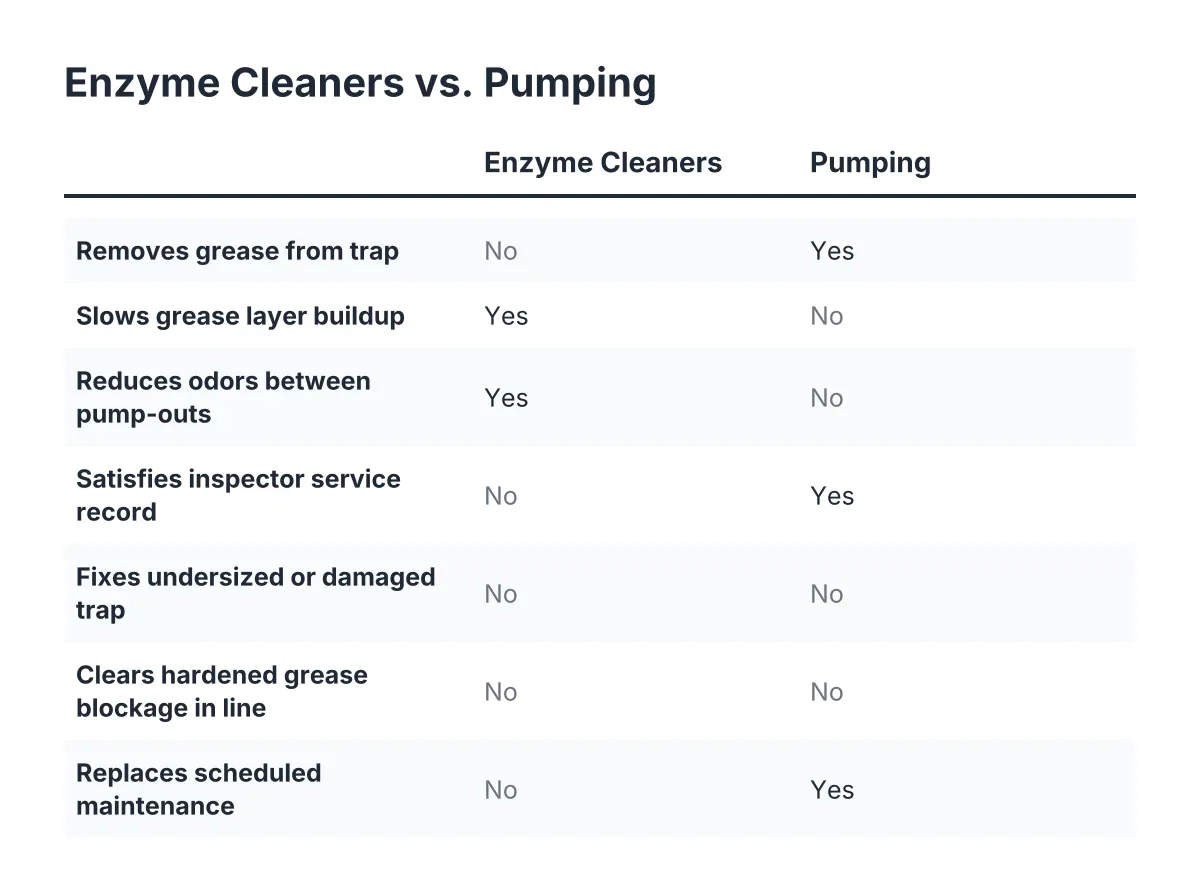
Enzyme and chemical additives get sold as a way to skip pump-outs. They do not remove grease from your system. At best they break grease into smaller particles that pass further down the line, where the grease cools, re-forms, and clogs pipes you cannot reach. Many sewer authorities prohibit additives for exactly this reason, because they push the grease problem into the public main.
However, that does not mean additives are useless in every situation; the honest framing is that nothing dissolves grease into something that disappears. The grease that enters your trap has to be physically removed and hauled away. A pump truck is the only tool that actually does that. Budget for pumping, use grease-smart kitchen habits to slow the buildup, and treat any additive as a minor supplement at most, never a substitute.
What Grease Trap Pumping Costs and How Long It Takes
Grease trap pumping costs depend mostly on trap size, how full it is, how accessible it is, and local disposal fees. A small under-sink trap at a sandwich shop costs less to service than a large in-ground interceptor behind a full-service restaurant. Neglect raises the price too; a trap full of hardened grease takes longer to clean than one serviced on schedule. No verified pricing data exists for this specific service in this area, so get a written quote based on your actual trap rather than trusting a flat number from the internet.
For a rough sense of scale from an adjacent service, the cost of septic tank pumping averages 427 dollars, ranging from 250 to 1,250 dollars or more depending on tank size and location, according to Angi data. Grease trap work prices differently because of waste handling and trap size, but the lesson transfers in 2026 just as it always has: routine service costs a fraction of what neglect costs.
On time, most routine pump-outs for a standard trap wrap up within a few hours, and a small indoor trap can go faster. A neglected trap, a hard-to-access lid, or a trap that needs its location confirmed first will add time. The waste does not stay local either; pumped waste is transported by truck to a treatment facility for disposal rather than being handled on site, which is part of what you pay for, as the New Hampshire Department of Environmental Services describes for septic waste.
When to Call a Pro Instead of Handling It Yourself
A kitchen staff can handle grease-smart habits: scraping pans, collecting fryer oil, and keeping a service log. Opening and emptying the trap is a different matter. The waste is regulated, the gases inside a trap can be hazardous, and disposal requires an approved facility. Call a professional service when:
- The trap has not been pumped in longer than you can document
- Drains are slowing down or odors are coming from floor drains
- An inspection is coming and you have no recent service record
- You bought a property and do not know where the trap is or what condition it is in
- Wastewater is backing up anywhere in the building, which is an emergency
That last one deserves emphasis. A backup means grease or solids have already escaped the trap, and pumping alone may not clear the line. This is a case where you should get a professional diagnosis rather than repeated DIY snaking, because the underlying grease coating will keep causing re-clogs until it is addressed properly.
Choosing a Grease Trap Pumping Service in Hesperia, CA
Choosing a grease trap pumping service in Hesperia, CA comes down to three things: complete pumping, legal disposal, and documentation you can hand to an inspector. A provider that delivers all three keeps you compliant and out of emergency territory. A provider that skims the trap and leaves no paperwork costs you more over time, no matter how low the invoice looks.
When you search for a grease trap pumping service near me, you will see national call centers, directory listings, and local crews mixed together. Sorting them takes about three questions:
- Do you pump the full contents, including bottom sludge, and scrape the walls and baffles, or do you skim the top?
- Where does the waste go, and can you confirm disposal at an approved facility?
- What documentation do I get after each visit, and will it satisfy a health inspection?
A fair quote should state the trap size or an estimate of it, whether disposal fees are included, and what happens if the trap turns out fuller or harder to access than expected. Vague quotes produce surprise invoices. In addition, ask whether the crew can locate a trap or septic tank with no visible lid, because in the High Desert plenty of properties have buried access points and no records to go with them.
Local knowledge matters here too. Many properties around Hesperia sit on septic systems rather than city sewer, so a kitchen's grease problem can threaten a drain field, not just a sewer lateral. A crew that handles both septic tank pumping and grease trap work understands how the two systems interact and can tell you whether a problem is in the trap, the line, the tank, or further downstream. One caveat worth stating plainly: if an inspection turns up structural damage to the trap, a collapsed baffle, or a failed line, pumping will not fix it, and you will need a repair quote from a qualified contractor before the system is reliable again.
Keep the Trap Boring
A well-managed grease trap is the least interesting thing in your building. It gets pumped on schedule, the records go in a file, and it never comes up during an inspection or a dinner rush. Every expensive grease story starts with one of the five mistakes above: skipping the schedule, accepting a skim job, losing the paper trail, treating the trap as a disposal, or trusting additives to do a pump truck's job.
If your trap is overdue, your records are missing, or you just took over a Hesperia property with a system nobody can explain, get it pumped, inspected, and documented before it decides the timing for you. Reach out to a local Hesperia septic and grease trap crew to book a service visit or get an estimate, and start the paper trail your next inspection will ask for.
If you need your septic tank serviced, Hesperia Septic can help.
Prefer to talk it through? Call (760) 249-7872 — a quick call is usually the fastest way to get a straight answer for your situation.