Residential Grease Trap Cleaning Cost in Hesperia, CA: What to Expect and How to Budget
If your home or small kitchen in Hesperia has a grease trap, you already know it needs regular service. The harder question is what the grease trap cleaning cost should be and how to schedule it so you never deal with a backup. This guide walks you through residential grease trap cleaning step by step, from pricing factors to setting up a recurring schedule, so you can budget for 2026 without guesswork and without worrying a company will find fake problems to upsell.
The same steps apply whether you have a small grease trap for a kitchen sink at home or a larger unit in a commercial kitchen, an RV park snack bar, or a small restaurant. The sizes change; the process does not.
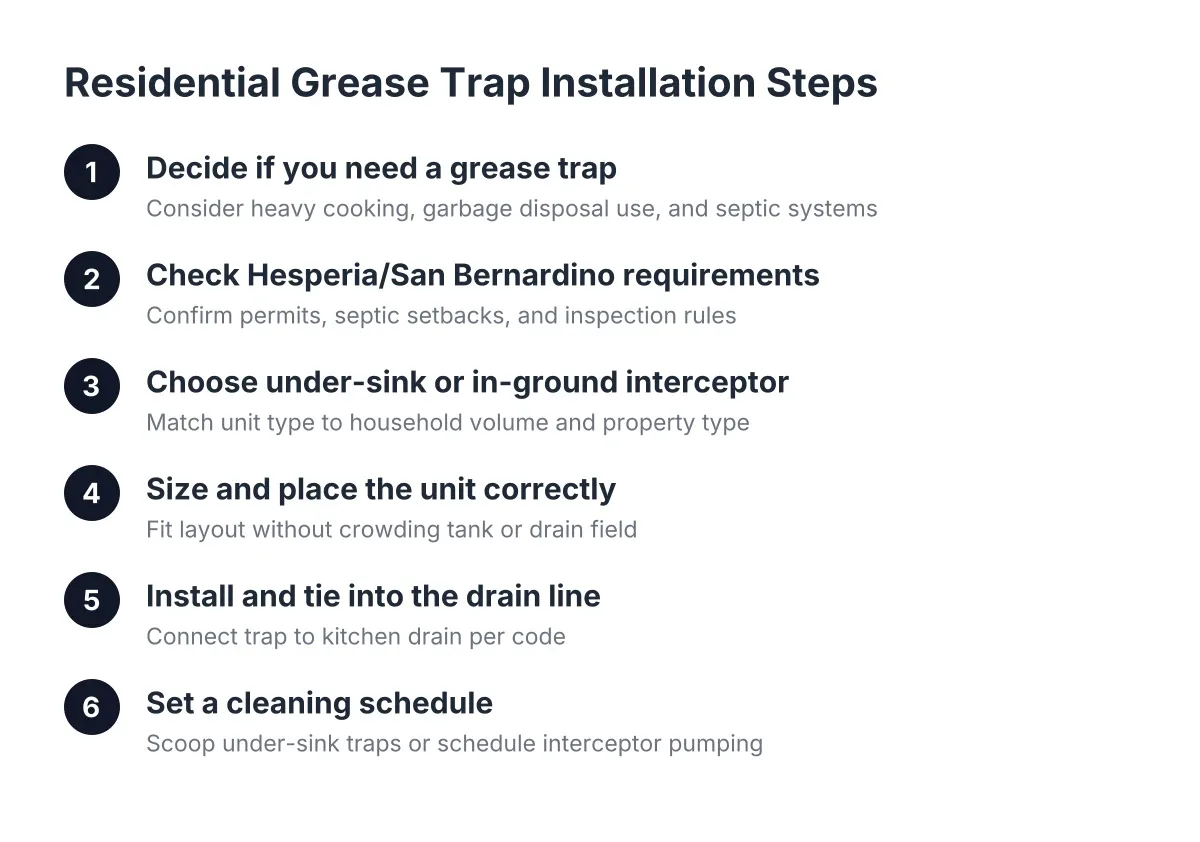
Step 1: Figure Out What Kind of Trap You Actually Have
Before you can get a fair price, you need to know what you are asking someone to clean. Pricing depends almost entirely on size and access, so this step saves you from vague quotes.
Most residential setups use a small under-sink grease trap, a metal or plastic box that holds somewhere in the range of 10 to 50 pounds of grease. Some larger homes and most commercial kitchens use a grease interceptor, an in-ground tank that can hold hundreds or thousands of gallons. The difference matters because a small indoor trap takes less time and less equipment, while an in-ground interceptor requires a pump truck, the same kind used for septic tank pumping.
Check these three things and write them down:
- Location: under the sink, in the floor, or buried outside
- Size: look for a capacity stamped on the lid, or note the rough dimensions
- Last service date: check for a sticker, a receipt, or a manifest from the previous owner
If you just bought the house and have no idea when the trap was last serviced, say so when you call. That is common, and an honest company will plan for a heavier first cleaning rather than surprise you with add-on charges later.
Step 2: What Affects Grease Trap Cleaning Cost
Residential grease trap cleaning cost is driven by four main factors: the size of the trap, how full and compacted the grease is, how easy the trap is to access, and how far the service truck has to travel. In the High Desert, where homes are spread out, travel distance matters more than it would in a dense city.
Here is how each factor plays out:
- Size. A small under-sink trap is a quick job. An in-ground interceptor needs a vacuum truck and takes longer, so it costs more.
- Condition. A trap serviced on schedule pumps out easily. A trap neglected for a year or more holds hardened grease that takes extra time to scrape and remove.
- Access. A trap under a kitchen sink with clear cabinet space is simple. A buried lid under landscaping or a trap in a tight crawl space adds labor.
- Scheduling. A routine, planned visit costs less than an emergency call. Same-day service when grease is already backing up into your sink carries a premium across the industry.
For a rough mental benchmark, consider that according to Angi data, septic tank pumping averages $427 nationally, ranging from $250 to $1,250 depending on tank size and location. Grease trap cleaning cost and service follows the same logic: small traps land well below that, and large in-ground interceptors can land in a similar range. Treat those numbers as illustrative, not a quote; the only accurate price comes after a company knows your trap's size, condition, and location.
Step 3: Get a Clear Quote Before Anyone Shows Up
You should never have to guess what the visit will cost. When you call for residential grease trap cleaning in Hesperia, give the company the details you gathered in Step 1 and ask for a price range tied to those specifics.
Ask these questions directly:
- Is the price based on trap size, or is it hourly?
- Does the quote include hauling and disposal of the grease, or is that extra?
- What happens to the price if the trap turns out to be fuller or more compacted than expected?
- Is there a discount or locked rate for recurring scheduled service?
A company that answers plainly is a company you can build a maintenance schedule with. A company that dodges the disposal question is a red flag, because hauling waste to a licensed facility is a real cost; grease and septic waste are trucked to a treatment facility for disposal rather than handled on site, as the New Hampshire Department of Environmental Services notes about pumped waste generally.
In addition, be cautious of anyone who insists on a long list of extra repairs sight unseen. A legitimate finding, like a damaged baffle, will come with something you can see for yourself at the time of service.
Step 4: Prepare the Site So You Are Not Paying for Extra Labor
Access problems are one of the quietest cost drivers in this business. A technician who spends twenty minutes digging out a buried lid or emptying a cabinet is time you are paying for.
Before the appointment:
- Clear the cabinet or floor area around an indoor trap
- Locate and expose the lid of an outdoor interceptor, or tell the company if you cannot find it so they can plan to locate it
- Make sure a pump truck can park within hose reach of an in-ground unit
- Keep pets and kids away from the work area during service
For example, suppose a homeowner in Hesperia has an in-ground interceptor with a lid buried under three inches of decorative gravel. If the lid is exposed before the crew arrives, the job is a straightforward pump-out. If the crew has to probe for it and dig, the visit runs longer and may cost more. Fifteen minutes of prep protects your wallet.
Step 5: Know What a Proper Cleaning Includes, Not Just a Pump-Out
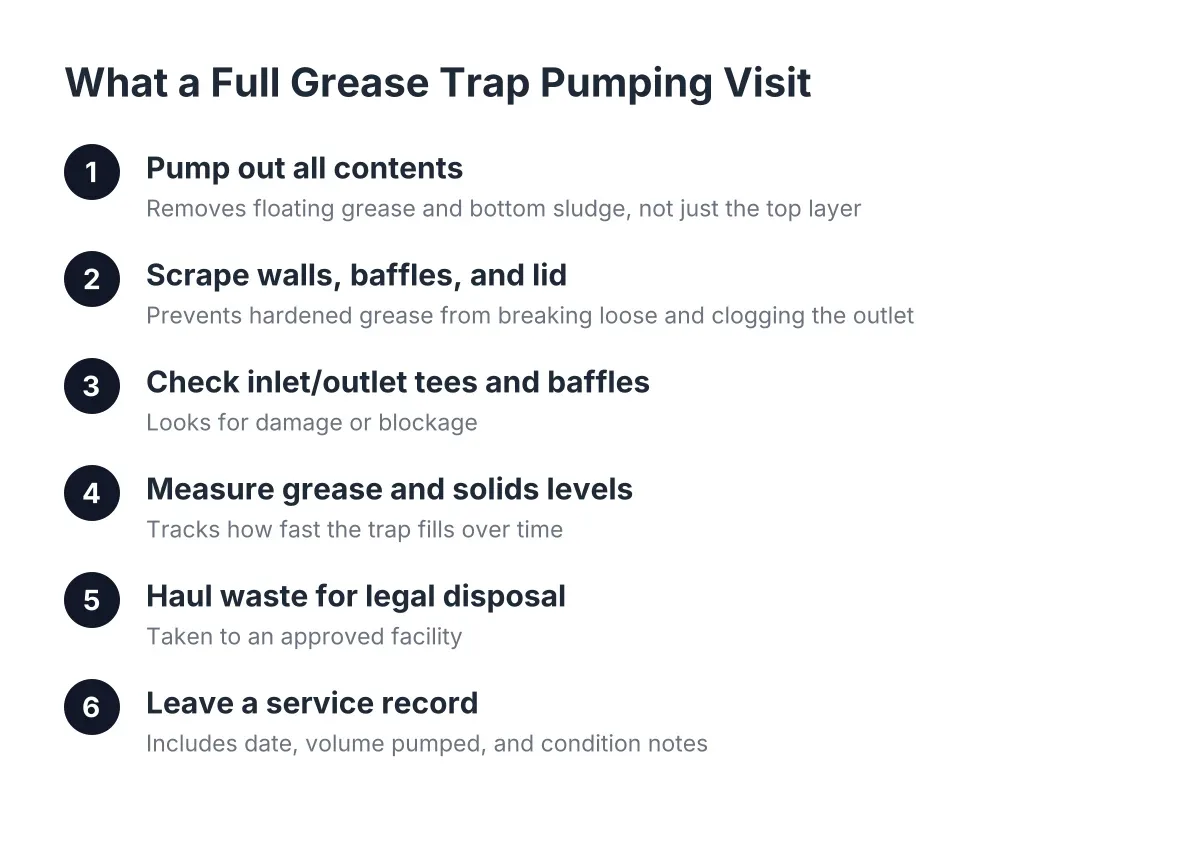
A full cleaning removes everything: the floating grease layer, the liquid in the middle, and the settled solids at the bottom. Then the technician scrapes the walls and baffles so hardened grease does not stay behind and shrink the trap's working capacity.
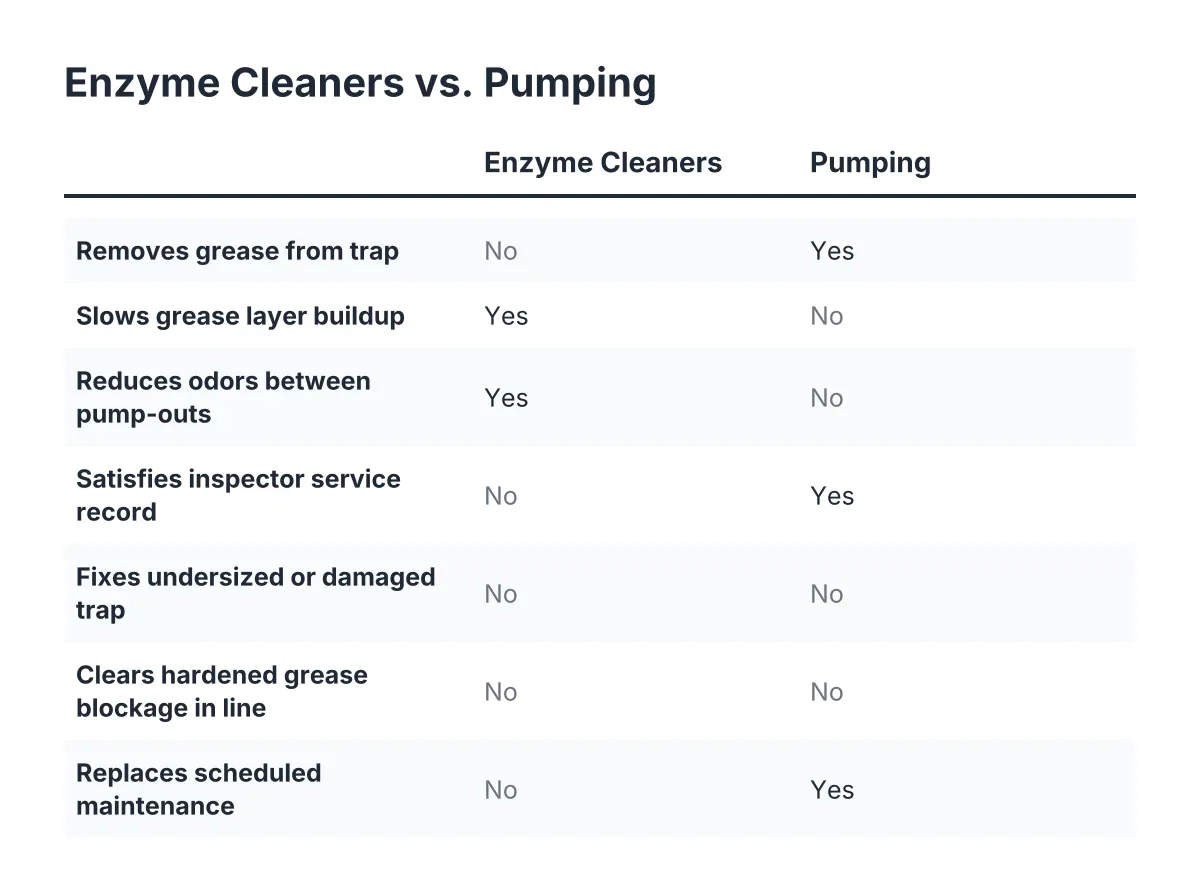
This matters because grease behaves differently than other waste. It clings to pipe walls and trap surfaces, so a partial pump-out that leaves a coating behind leads to faster refilling and earlier clogs. If grease has already migrated into your drain line, clearing it usually requires a jetter or similar tool that cleans the full pipe wall; punching a hole through the clog with a small snake only buys you a few weeks before it closes up again.
During the visit, a good technician will also give the trap a quick visual check for cracked baffles, corrosion, or a damaged lid. That is the kind of honest, show-you-the-problem inspection that keeps small issues from becoming plumbing repairs.
Ask for paperwork before the truck leaves. A service record or manifest showing the date, volume removed, and disposal destination is your proof of maintenance. Homeowners rarely need it for inspectors, but it matters at resale, and for any small commercial kitchen or RV park in the High Desert it is the document that keeps you compliant with health code requirements.
Step 6: Set a Recurring Schedule for Your Residential Grease Trap
A residential grease trap should be cleaned on a recurring schedule based on how fast it fills, not on when it starts to smell. For most households, that means having the first professional cleaning set a baseline: the technician sees how full the trap is, you note how long since the last service, and you set the interval from there.
Odor, slow kitchen drains, or visible grease at the trap opening mean you waited too long. The goal of a schedule is to never see those signs. Many commercial kitchens follow a rule of pumping once the grease and solids layer reaches about a quarter of the trap's depth, and that is a sensible benchmark for homes too.
There is a real payoff to staying ahead of it. According to the U.S. Environmental Protection Agency, grease from restaurants, homes, and industrial sources is the most common cause of reported sewer blockages, responsible for 47% of cases. On a septic system, that same grease can reach your tank and drain field, and the EPA estimates septic repair or replacement typically runs $5,000 to $15,000. A grease trap cleaning that costs a few hundred dollars is cheap insurance against that.
Many companies that handle septic work in the Hesperia area also offer grease trap pumping on a recurring basis, so you can often put your grease trap and your septic tank on the same maintenance calendar with one local vendor. That is one phone call a year instead of two emergencies.
Step 7: Keep Grease Out of the Trap Between Cleanings
The cheapest gallon of grease to remove is the one that never goes down the drain. Between service visits, a few habits stretch the interval and lower your annual cost:
- Scrape pans and plates into the trash before rinsing
- Pour cooled cooking oil into a sealed container and throw it away, never down the sink
- Use sink strainers to catch food scraps
- Run cold water, not hot, when rinsing greasy dishes; hot water carries grease past the trap before it can solidify and separate
For perspective on how much grease a busy kitchen can produce, Wastewater Digest reports a single restaurant can release between 800 and 17,000 pounds of grease into the sewer system each year. Your home kitchen is nowhere near that, but the lesson scales down: every pound you keep out of the drain is capacity you are not paying to pump.
One honest limitation: if your trap is undersized for your kitchen, backs up repeatedly between cleanings, or shows cracks or corrosion, no cleaning schedule will fix it. At that point, bring in a professional to evaluate whether the trap needs repair or replacement, because local plumbing code and sizing rules come into play.
What This Looks Like in Practice
Say a family in Hesperia buys a home with an under-sink grease trap and no service records. In that scenario, a sensible plan looks like this: they measure the trap, call a local crew with the details, get a quoted range up front, clear the cabinet before the visit, and ask for a service record when the job is done. The technician notes the trap was about half full and suggests a check-in a year out.
Total time invested: one phone call and fifteen minutes of prep. Total outcome: a known cost, a known schedule, and no surprise backup the week relatives visit. That is the whole point of treating residential grease trap cleaning as routine maintenance instead of a crisis response. Set the schedule once in 2026, put it on the calendar, and stop thinking about it.
If you need your septic tank serviced, Hesperia Septic can help.
Prefer to talk it through? Call (760) 249-7872 — a quick call is usually the fastest way to get a straight answer for your situation.