Septic Tank Cost for Commercial Accounts in Hesperia: Grease Traps, Holding Tanks, and Rentals
If you run a restaurant, manage a rental, or operate an RV park around Hesperia, commercial septic service cost questions hit differently than they do for a homeowner. You are not pumping one tank every few years. You might be paying for grease trap pumping every quarter, holding tank pump-outs all season, and the occasional tenant emergency on top of it. This guide breaks down what each type of service actually involves, what drives the price up or down, and how to tell whether a quote you received is fair. The goal is simple: no surprise line items, no manufactured upsells, and enough detail that you can compare vendors with confidence in 2026.
Why Commercial Septic Pricing Works Differently Than Residential
A homeowner calls once every few years, gets a pump-out, and forgets about it. You cannot afford that pattern. A grease trap flagged by the health inspector, a tenant calling about a smell, or a holding tank backing up during peak season all cost you money beyond the pump truck invoice.
That changes how you should think about price. The question is not just what one pump-out costs. It is what a year of reliable service costs, and what a missed service costs you in citations, lost tenants, or closed doors.
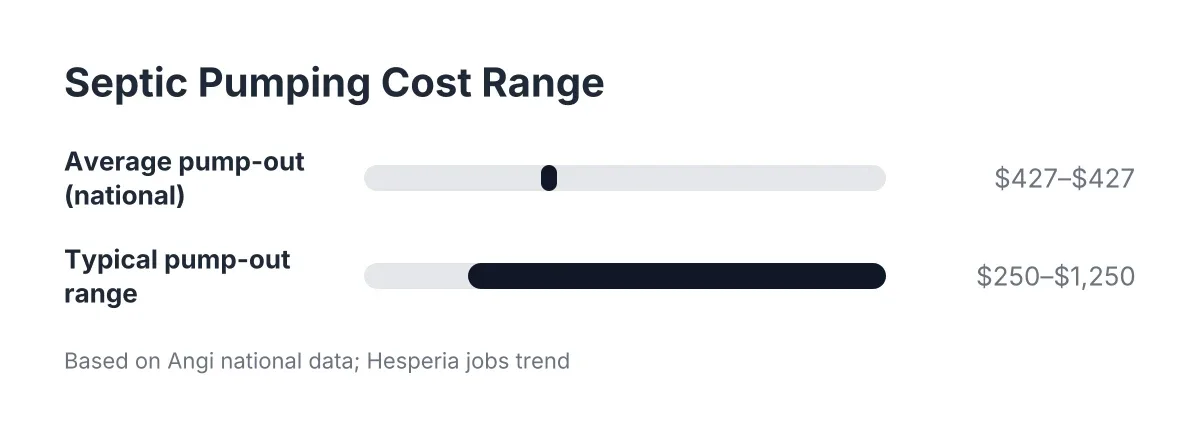
For context on the baseline, residential septic tank pumping averages $427 and ranges from $250 to $1,250 or more depending on tank size and location, according to Angi data. Commercial grease trap and holding tank work often falls in a similar range per visit, but the frequency is what shapes your annual budget. A restaurant on a quarterly grease trap schedule is buying four visits a year, not one visit every three years.
Supply and demand also matter locally. Pricing in any area reflects how many pump trucks operate there relative to the number of septic-served properties. The High Desert has a large base of septic systems, which keeps the market competitive compared to areas where one truck covers an entire county.
Commercial Septic Service Cost Breakdown by Type
Septic tank costs break into a few distinct service categories, and each prices differently: routine pumping, grease trap service, holding tank pump-outs, inspections, and emergency calls. Knowing which category your job falls into is the first step to judging a quote, because a fair price for one service can be a padded price for another.
Grease trap pumping
Grease traps are their own world. They fill faster than septic tanks because they catch fats, oils, and grease from a working kitchen, and health code sets the schedule, not your preference. Pricing typically depends on trap size, how full it is, and how often it gets serviced.
Here is the part operators miss: a trap that goes too long between pump-outs costs more per visit. Hardened grease takes longer to remove, and a crew may need to scrape walls and baffles rather than just vacuum liquid. Staying on schedule usually produces a lower, predictable per-visit price. Letting it slide produces a higher one, plus the risk of an inspector finding it first.
Ask any vendor whether their price includes a full pump-down and scrape, or just skimming the surface layer. Skimming is cheaper on the invoice and more expensive over the year, because the trap fills back up faster.
RV and holding tank pumping
Holding tanks have no drain field. Everything that goes in must be pumped out, which means service frequency tracks usage directly. An RV park in peak season might need weekly or biweekly pump-outs on shared holding tanks, while an off-grid cabin might need two visits a year.
Pricing here usually follows gallons removed and trip distance. If your property sits well outside Hesperia proper, expect a travel component. That is a legitimate charge, not a hidden fee, as long as it appears on the quote before the truck rolls.
Rental property septic pumping
For landlords, the service itself prices like residential pumping. The complication is logistics. You are often not on-site, the tenant may not know where the tank is, and access problems get discovered at the worst time.
Two things keep rental septic costs down. First, know where your tank lids are before there is a problem; septic tank locating is a billable service, and paying for it during an emergency is the expensive way to learn your own property. Second, arrange for the crew to work without you there. A vendor who can coordinate with a tenant, pump the tank, and send you the invoice and paperwork saves you a half day per service call.
Inspections
The EPA recommends that the average household have its septic system inspected at least once every three years, and rental properties should follow at least that rhythm. An inspection checks tank condition, baffles, and liquid levels, and it catches problems while they are still cheap.
One practical note on inspection pricing: an inspection often costs close to what a pump-out costs, because the truck, the crew, and the dig to the lid are the same. Therefore, if the tank is due anyway, combining pumping and inspection in one visit is usually the better value than paying for each separately.
Emergency service
Emergency septic pumping and backup response carry a premium over scheduled work. After-hours calls, same-day dispatch, and overflow cleanup all cost more than a planned visit. The premium is legitimate; the problem is when a vendor treats every call as an emergency to justify emergency pricing. If you called on a Tuesday morning for a non-urgent pump-out and the quote carries an emergency surcharge, ask why.
What Drives Commercial Septic Service Costs Up or Down
The cost of septic tank service on any given job comes down to a handful of physical factors: tank or trap size, how full it is, how hard it is to reach, how far the truck travels, and whether the visit is scheduled or urgent. Every legitimate line item on a quote should trace back to one of these.
- Size and volume. Bigger tanks and traps hold more waste, and disposal fees scale with gallons. A small under-sink grease trap and a large in-ground interceptor are different jobs.
- Access. Tanks buried deep without risers require digging before pumping can start. If a crew spends an hour excavating to reach your lid, that time shows up on the bill. Installing risers is a one-time cost that lowers every future visit.
- Condition. A trap or tank serviced on schedule pumps fast. One packed with hardened grease or heavy sludge takes longer and may require extra cleaning labor.
- Distance. Properties far from the service area add drive time and fuel. Expect this as a stated travel charge, not a buried one.
- Timing. Scheduled recurring service is the cheapest way to buy pumping. Emergency and after-hours work costs more per visit.
- Disposal. Pumped waste gets hauled by truck to a treatment facility for disposal rather than processed on-site, according to the New Hampshire Department of Environmental Services, and disposal fees are part of every job.
Notice what is not on that list: mystery "environmental fees" with no explanation, mandatory additive treatments, or surprise charges added after the work is done. A fair quote itemizes the factors above. A padded quote hides behind vague line items.
How to Judge a Commercial Septic Quote in Hesperia
A fair commercial quote names the service, the expected volume or tank size, the access conditions, any travel charge, and the disposal component, all before the truck arrives. If a vendor cannot or will not break the price down that way, treat the total number with suspicion, no matter how low it looks.
When you call for pricing on grease trap pumping, holding tank service, or rental septic pumping, have these answers ready:
- What and where. Grease trap, septic tank, or holding tank, and the property address. Location affects travel.
- Size, if you know it. Trap capacity or tank size narrows the estimate. If you do not know, say so; a vendor who quotes a hard number without knowing the size is guessing.
- Access. Are the lids exposed, under risers, or buried? Buried lids mean dig time.
- Last service date. A trap pumped three months ago and a trap pumped three years ago are different jobs.
- Urgency. Scheduled, soon, or right now. Be honest; emergency pricing exists for real emergencies.
In addition, ask every vendor two questions. First, is the quoted price all-in, or are disposal and travel billed separately? Second, do you provide a service record or manifest showing where the waste went? For a restaurant, that paperwork is your proof of compliance when the health inspector asks. For a landlord, it is your habitability documentation. A vendor who cannot produce it is a vendor you cannot use for compliance-driven work.
A realistic example of recurring service math
Suppose a single-location restaurant in Hesperia has a mid-sized in-ground grease trap on a quarterly schedule. Say each scheduled pump-out runs somewhere in the $200 to $700 range that is typical for single grease trap or holding tank service; that is roughly $800 to $2,800 a year as an illustrative estimate, depending on trap size and condition.
Now suppose the owner skips two quarters to save money. The trap overfills, grease hardens, and the next visit takes twice the labor plus a full scrape-down. In that scenario, the single catch-up visit can cost more than the two skipped visits combined, and if the health inspector arrives first, a citation and a forced re-inspection land on top. The recurring schedule was never the expensive option. It just looked that way on a monthly budget.
Where Skipping Service Gets Expensive
Pumping and trap service are the cheap end of septic ownership. The expensive end is what happens when solids or grease escape the tank and damage what comes after it.
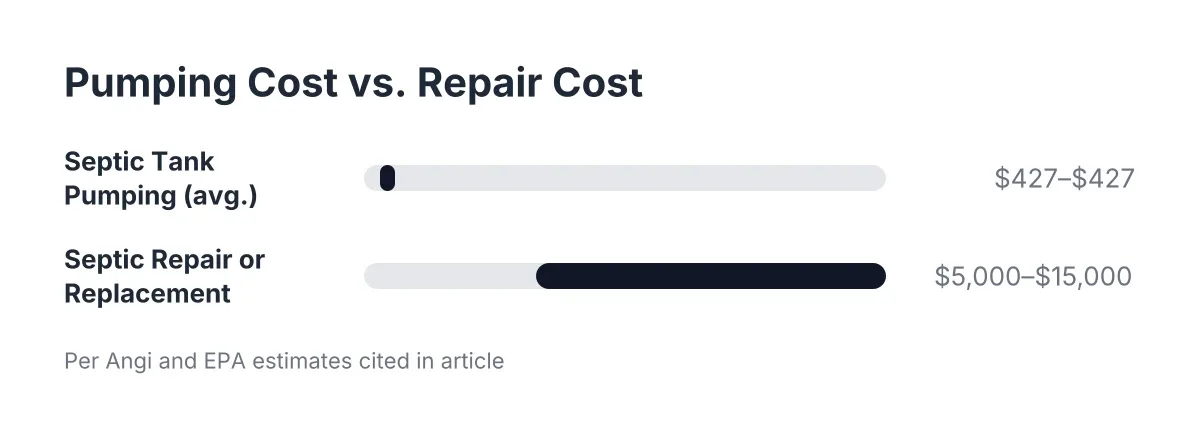
A conventional septic system has two main components, the tank and the drain field, according to the U.S. Environmental Protection Agency. The tank settles out solids; the drain field disperses the clarified liquid into the soil. When a tank goes too long without pumping, solids push past the outlet baffle into the drain field, and a clogged drain field is not a pumping problem anymore. The EPA estimates septic repair or replacement typically costs between $5,000 and $15,000, far more than routine pumping.
For rental owners, water waste compounds the risk. A single leaky or running toilet can send as much as 200 gallons of extra water per day into a septic system, according to the EPA. Tenants rarely report a quietly running toilet, so that extra load floods the tank, pushes solids out, and shortens the drain field's life without anyone noticing. A note in your lease asking tenants to report running toilets and slow drains is free protection.
Occupancy drives frequency too. Penn State Extension notes that an active family of four generally needs pumping every two to three years because of higher solids and liquid production. A rental with four or five occupants needs more frequent service than the same house with one tenant, so set the schedule by who lives there, not by the calendar you used for the last tenant.
One honest limitation: no article can price your specific trap or tank from a distance. Size, condition, access, and local disposal fees all vary, and some situations, such as a suspected drain field failure or a trap that fails repeated inspections, need a professional on-site before anyone can quote responsibly. Use the ranges here to judge whether a quote is in the right neighborhood, not as a substitute for an on-site look.
Turning Septic Service Into a Line Item Instead of a Fire Drill
The operators who spend the least on septic over five years are the ones who stopped treating it as an emergency category. Here is the implementation checklist, now that you have chosen to get this handled:
- Document what you have. Trap size, tank location, lid access, and last service date for every property. If you do not know where a tank is, schedule a locating service once and mark it; never pay to find the same tank twice.
- Set the schedule by load. Kitchen volume for grease traps, occupancy for rentals, and season for holding tanks. More than one in five U.S. households rely on septic or small cluster systems according to the EPA, so this is normal infrastructure management, not an oddity.
- Fix access once. If lids are buried, add risers. It is a one-time expense that cuts labor off every future visit and makes no-contact service possible when you are off-site.
- Combine visits. Pump and inspect in the same visit where the schedule allows, since the truck and the dig are already paid for.
- Keep the paperwork. File every service record and disposal manifest. For restaurants, that file is your answer to the inspector. For landlords, it is your answer to a habitability complaint.
- Get the itemized quote in writing before each new property or service type. Recurring vendors should hold predictable per-visit pricing; if a number jumps, the quote should show which factor changed.
Handled this way, septic service stops being a thing that interrupts your week and becomes a known cost you budget like insurance or trash service. A local Hesperia crew that handles grease trap pumping, holding tank pump-outs, rental septic pumping, and the occasional genuine emergency under one roof means one phone number, one paper trail, and one vendor who already knows where your lids are. That is the whole point of getting pricing right once: you make the decision a single time, and then the system just runs.
If you need your septic tank serviced, Hesperia Septic can help.
Prefer to talk it through? Call (760) 249-7872 — a quick call is usually the fastest way to get a straight answer for your situation.