Portable RV Waste Tank vs. Mobile Pump-Out Service: A High Desert Owner’s Guide
If you own an RV, a cabin, or a rental property in the High Desert, you have two basic ways to deal with a full holding tank. You can haul the waste yourself with a portable RV waste tank, or you can have a mobile pump-out crew come to you. Both work. But they work for different people, different properties, and different situations. This guide walks through how a portable RV waste tank actually works, where it falls short in Hesperia conditions, and when hiring a local crew that services RVs, remote cabins, and holding tanks makes more sense than hauling waste across town in a tote.
This matters most for the properties other crews skip. Maybe you just bought a few acres outside Hesperia with a cabin on a holding tank and no records. Maybe you park an RV on a rental lot between tenants. Either way, the waste has to go somewhere, and you need to decide whether that job is yours or a professional's.
What a Portable RV Waste Tank Is and How It Works
A portable RV waste tank, sometimes called a tote tank or honey wagon, is a wheeled plastic tank you fill from your RV's holding tank valves. You connect a sewer hose from the RV's outlet to the tote, open the valve, and gravity does the work. Then you tow or roll the full tote to a dump station and empty it there.
The appeal is obvious. You empty your black and gray tanks without moving the RV. For someone parked long-term on a lot, in a driveway, or at a seasonal site, that means no breaking camp, no unhooking utilities, and no driving a 30-foot rig to a dump station every week.
Most portable RV waste tanks on the market run from about 15 to 36 gallons. The larger sizes often come with four wheels and a tow handle so you can pull them slowly behind a vehicle at walking speed. The smaller ones you roll by hand. A typical setup also needs a dedicated sewer hose, a sewer cap with a garden-hose rinse fitting, and gloves you only use for this job.
The Basic Workflow, Step by Step
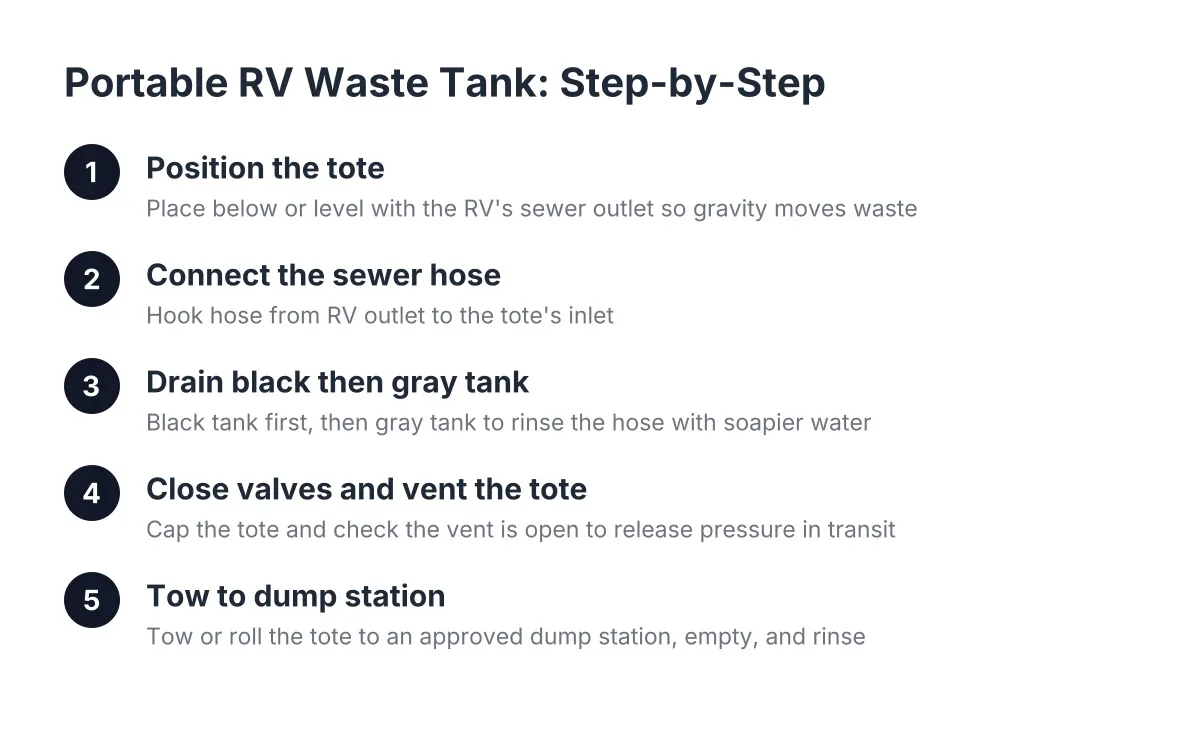
If you go the portable route, the process looks like this:
- Park the tote below or level with your RV's sewer outlet so gravity can move the waste.
- Connect the sewer hose from the RV outlet to the tote's inlet.
- Open the black tank valve first and let it drain, then the gray tank valve to rinse the hose with soapier water.
- Close all valves, cap the tote, and check that the vent is open so pressure can escape during transport.
- Tow or roll the tote to an approved dump station, empty it, and rinse it out.
That vent step matters more than people expect. A sealed tank full of waste builds pressure as it sloshes and warms up, and High Desert heat speeds that up. An unvented or over-filled tote can burp waste at the worst possible moment, usually when you open the cap at the dump station.
Where the Portable RV Waste Tank Approach Breaks Down
A portable RV waste tank is a strong fit for one narrow situation: a single RV, parked near a vehicle, within reasonable driving distance of a legal dump station, owned by someone willing to do a messy chore on a regular schedule. Step outside that situation and the math changes fast.
First, capacity. A 36-gallon tote sounds big until you realize many RV black tanks hold 40 gallons or more, and that is before you touch the gray tank. You may need two or three trips per full pump-out. Each trip means hooking up, draining, towing at walking speed or trailer speed, waiting at the dump station, and rinsing.
Second, distance. In the High Desert, the nearest approved dump station may not be close. Towing a tote behind a truck on washboard dirt roads outside Hesperia is slow, and the tanks are not built for highway speeds. If your cabin or rental sits 20 minutes from pavement, the portable option turns a 30-minute chore into half a day.
Third, the physical reality. Waste is heavy. Water weighs over eight pounds per gallon, so a full 36-gallon tote weighs around 300 pounds. Rolling that across soft sand or gravel by hand is not realistic for most people, and lifting it into a truck bed is out of the question.
Fourth, who actually does the work. If you are a landlord with a septic-served rental or an RV pad on the property, the portable approach assumes you or your tenant will handle raw sewage correctly every time. Most tenants will not, and most lease agreements should not ask them to. One spilled tote near a property line is a problem you do not want to explain.
When Mobile Pump-Out Service Beats Hauling It Yourself
Mobile RV holding tank pumping flips the whole model. Instead of you bringing the waste to a dump station, a vacuum truck comes to the RV, cabin, or holding tank and empties it on site. The crew connects to your tank or outlet, pumps the contents into the truck, and hauls everything away. Septic waste pumped from tanks is transported by truck to a sewage treatment plant for disposal, according to New Hampshire Department of Environmental Services, so nothing stays on your property.
The service case is strongest in exactly the situations where a tote fails:
- Remote cabins and parcels on holding tanks, where the nearest dump station is a long haul away.
- RVs parked long-term on rental lots, where the owner does not live on site.
- Campgrounds and RV parks with multiple tanks that need regular service on a schedule.
- Anyone physically unable or unwilling to handle 300 pounds of sewage on wheels.
- Full or backed-up tanks that need emergency attention, not a weekend project.
For example, suppose you just closed on five acres east of Hesperia with an older cabin and no septic records. You find a buried tank with a plugged outlet and realize it is a holding tank, not a septic tank; it collects everything and treats nothing. A holding tank like that has no drain field. It fills, and then it must be pumped by a hauler who can legally transport the waste. No portable tote solves that problem, because the tank may hold hundreds of gallons and sits nowhere near a dump station. In that scenario, the right move is a locate, an inspection, and a scheduled pump-out from a local crew, all before you decide what the property is worth to you.
That last point matters for buyers. Properties served by holding tanks generally carry ongoing pumping costs and water-use limits that a septic system with a working drain field does not. Knowing which type of system you have, and what it costs to keep empty, should factor into any purchase or rental decision.
What a Good Pump-Out Service Includes
When you hire a crew for RV or holding tank pumping in the Hesperia area, the core scope of work should cover:
- Pumping the black tank, gray tank, or fixed holding tank fully, not just skimming liquid off the top.
- Legal transport and disposal of the waste at an approved treatment facility.
- A basic visual check of valves, fittings, and the tank opening while they are there.
- A clear record of the service, which matters if you are a landlord who needs documentation for your files or for a future sale.
Some things usually cost extra, and a straight answer up front beats a surprise on the invoice. Expect added charges for long rural drive distances, tanks that are hard to access or buried with no riser, heavy solids buildup that needs extra rinse water and time, and after-hours or emergency calls. The pumping itself on an RV is quick; a typical crew can empty standard RV tanks in well under an hour once they are connected, though buried or problem holding tanks take longer.
On fixed holding tanks and septic tanks, solids are where the time goes. Tanks that have gone too long between pump-outs, or that have collected wipes, grease, and other non-degradable items, require more effort because large solids can clog the vacuum hose. That is one more reason to keep a holding tank on a schedule instead of waiting for it to back up.
Questions to Ask Before You Book
Three questions sort out a legitimate local operator from a thin listing page:
- Do you service RVs and holding tanks at my location, including dirt-road and remote properties? Some crews skip anything off pavement; a High Desert operator should not flinch at it.
- Where does the waste go? The answer should be an approved treatment facility, stated plainly.
- What does the quote include? A fair quote names the pumping, the disposal, and any likely extras like access digging or long drive time, before the truck rolls.
If you are comparing against buying a portable RV waste tank instead, run the honest math: the tote, hose, and fittings up front, plus your time, fuel, and dump station fees every single trip, against a service call whenever the tank is full. For a weekend camper near a dump station, the tote often wins. For a holding tank, a rental property, or a remote parcel, the truck wins.
High Desert Conditions That Change the Decision
Hesperia and the surrounding High Desert add a few local wrinkles that generic RV advice ignores.
Heat is the first. Summer temperatures speed up odor and gas buildup in any sealed tank, whether that is an RV black tank, a tote sitting in the sun, or a cabin holding tank. A portable tote left full in July heat becomes unpleasant fast, and pressure builds in any tank without a working vent. Mobile service on a set schedule removes the temptation to let a full tank sit.
Soil and terrain come next. Sandy, soft ground makes hand-rolling a loaded tote nearly impossible, and washboard dirt roads are hard on tote wheels and axles that were designed for campground pavement. Vacuum trucks built for local roads handle those approaches routinely.
Distance is the third factor. Much of the area around Hesperia is rural by design. Septic and holding tanks exist here precisely because there is no centralized sewer; homes in cities connect to municipal treatment, while areas without sewer service rely on onsite systems, according to Environmental Finance Center Network. The EPA estimates about 20 percent of U.S. households rely on onsite wastewater systems, and in the High Desert that share runs through entire neighborhoods and unincorporated parcels. The flip side of that independence is that waste disposal is your job to arrange, one way or the other.
For landlords, there is a 2026 planning angle too. If you own one to five septic-served or holding-tank rentals in the area, build pump-out timing into your turnover checklist. A tank serviced between tenants, with the paperwork in your file, prevents the mid-lease emergency call that costs more and sours the tenant relationship. If the property has an RV pad, decide in the lease whether tank service is on you or the tenant, and if it is on the tenant, do not expect a portable tote to be handled well.
When to Call a Pro Instead of Reaching for the Tote
Some situations are a clear line. Call a professional, not a dump station, when:
- The tank serving the property is a fixed holding tank or septic tank, not a wheeled RV tank. These hold far more than any tote and require a licensed hauler.
- You smell sewage, see wet ground near the tank, or have slow drains backing up. Those are septic backup warning signs, not routine pump-out signals.
- You cannot find the tank at all. On a property with no records, a septic tank locating service finds and marks the tank and lid so you know what you are dealing with before you spend another dollar.
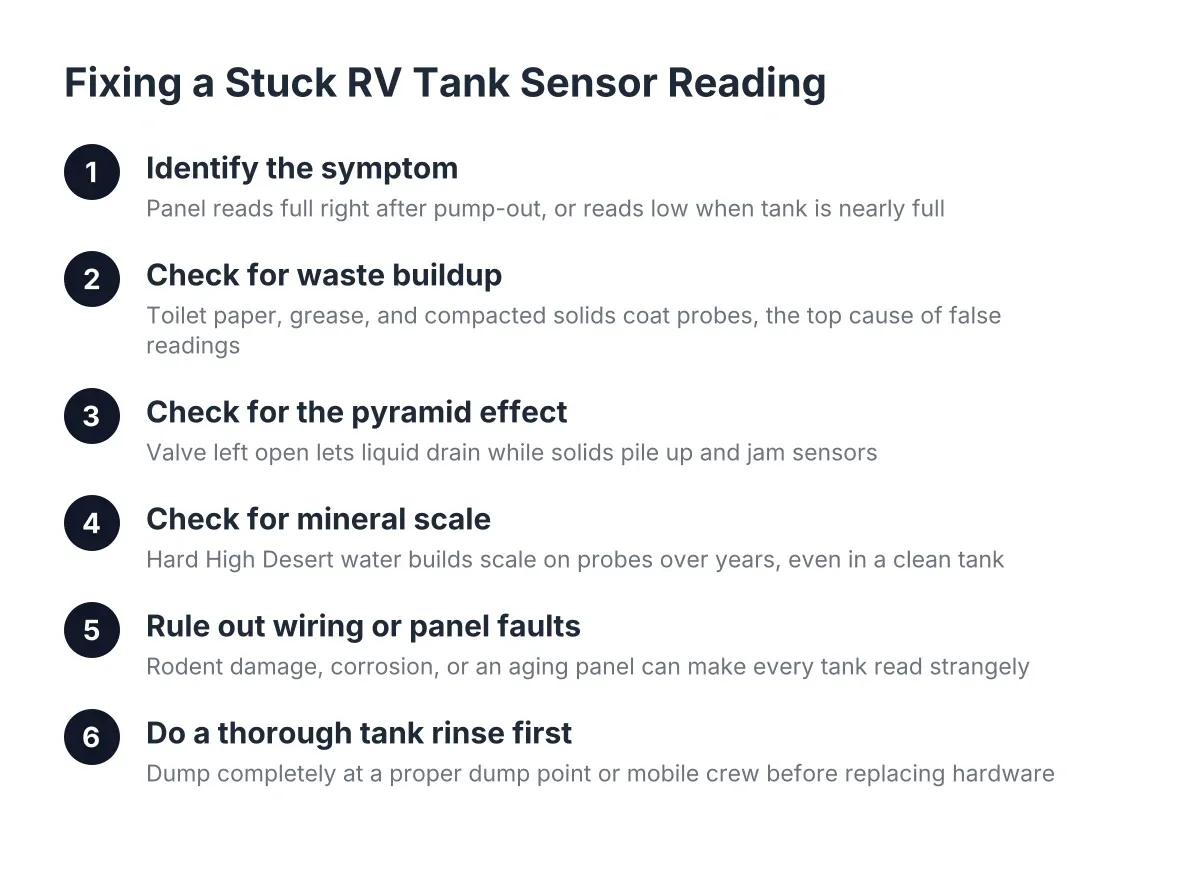
- The RV tank will not drain, the valve is stuck, or sensors read full right after a dump. Forcing a stuck valve is how small problems become big ones.
- You are mid-escrow and need a written picture of the system's condition. A septic inspection costs little compared to what it can reveal; the EPA estimates septic repair or replacement typically runs $5,000 to $15,000, far more than routine pumping.
DIY still has its place. Dumping your own RV tanks at an approved station, rinsing your tote, treating your tanks, and keeping wipes and grease out of the system are all squarely homeowner territory. The line is fixed tanks, backups, and anything buried.
One honest limitation: no article can tell you what is actually under your dirt. If you bought land with no records, the only reliable path is a physical locate and inspection by someone who opens the lid and looks. A buried tank can surprise even experienced crews, and condition calls made from the surface are guesses.
Making the Call for Your Property
Here is the short version. A portable RV waste tank is a tool for one RV, one owner, and a nearby dump station. Mobile RV septic pumping near Hesperia is the answer for everything else: holding tanks, remote cabins, rental properties, campgrounds, and any tank too big or too far gone for a tote. People sometimes call this honey bucket RV pumping, and the idea is the same either way; a truck comes to the tank instead of the tank coming to the truck.
If you are in Hesperia or the surrounding High Desert and you have an RV tank that needs emptying, a holding tank with no service history, or a parcel where you cannot even find the lid, reach out to a local septic crew for an estimate. A short call to describe your property, your access, and your tank type is usually enough to get a straight answer on scope and scheduling, and it beats guessing with 300 pounds of waste on wheels.
If you need your septic tank serviced, Hesperia Septic can help.
Prefer to talk it through? Call (760) 249-7872 — a quick call is usually the fastest way to get a straight answer for your situation.