RV Tank Pumping Near Me in Hesperia: How Mobile Pump-Out Service Works
If you own an RV, a remote cabin, or a small campground in the High Desert, you have probably typed "rv tank pumping near me" into a search bar at least once. Maybe the black tank is full and the nearest dump station is 40 minutes away. Maybe your cabin's holding tank is creeping toward capacity before a weekend of guests. Either way, the problem is the same: the waste has to go somewhere, and hauling it yourself is messy, slow, and sometimes not even legal. This guide explains how mobile pump-out service works in and around Hesperia, what it includes, what it tends to cost, and how to pick a crew that will actually show up at a property other companies skip.
Why the High Desert Is a Different Animal for Tank Pumping
Hesperia sits in a stretch of the High Desert where RVs are not just vacation vehicles. They are guest quarters on family land, temporary housing during a build, and full-time homes on rural parcels. Cabins out past the paved roads often run on holding tanks instead of full septic systems because the lot never got a drain field.
That creates a recurring problem most city dwellers never think about. A holding tank has no drain field and no soil absorption area. Everything that goes in stays in until someone pumps it out. A typical residential septic system, according to the US EPA, has two main components: a tank that clarifies wastewater and a drain field that disperses the liquid into the ground. A holding tank only has the first part. So while a septic tank might go years between pump-outs, a holding tank fills on a schedule set by how much water you use.
Distance makes it worse. Plenty of pump trucks will happily service a tract home two blocks off Main Street. Fewer want to run a heavy truck up a washboard dirt road to a cabin near the edge of the valley. That is the gap mobile, on-demand pump-out service is built to fill: RV traffic passing through the High Desert, seasonal campground operators, and cabin owners whose properties sit past where some crews are willing to drive.
What Mobile RV Tank Pumping Near Hesperia Actually Includes
A mobile pump-out means the truck comes to you. You do not break camp, drive to a dump station, wait in line, and wrestle a sewer hose in a parking lot. The service vehicle carries a vacuum pump and a storage tank, and the technician does the dirty work at your site.
A standard visit for an RV usually covers:
- Pumping the black tank (toilet waste), which is the main event
- Pumping the gray tank (sink and shower water) if you want it emptied too
- A fresh-water rinse of the tank when the setup allows it, which helps knock down odor and keeps sensor readings honest
- Hauling the waste away to a licensed disposal facility
That last point matters more than people realize. Waste pumped from tanks is trucked to a sewage treatment plant for disposal rather than processed on-site, according to the New Hampshire Department of Environmental Services. A legitimate hauler carries the cost and responsibility of legal disposal. A guy with a trailer tank and no disposal arrangement does not, and where that waste ends up becomes your problem if it gets traced back to your property.
For cabins and campgrounds, the visit looks similar but bigger. A cabin holding tank or a campground's shared holding tank holds far more than an RV's onboard tanks, so the truck's capacity matters. If the pump truck is smaller than the tank it is emptying, the operator has to pump part of the load, drive to the disposal site, come back, and finish. That adds drive time and disposal trips, which usually shows up in the price. It is a fair question to ask before booking: can one truck handle my tank in one trip?
What Usually Counts as Extra
Most crews treat a few things as add-ons rather than part of the base pump-out:
- Digging to expose a buried holding tank lid or cleanout
- Deep tank cleaning or washing down caked solids, beyond a basic rinse
- Long hose runs when the truck cannot park near the tank or RV
- After-hours or emergency visits
You can control the first one yourself. If your cabin tank access is buried, find it and uncover it before the truck arrives. Companies commonly charge extra for digging out access, and it is honest work you can do with a shovel on a Saturday.
When Should You Search for RV Tank Pumping Near You?
Call for a pump-out when your black tank reads two-thirds full or more, when sensors stop making sense, when you smell sewage inside the rig, or when a trip or guest season is coming and you do not want to manage waste mid-stay. Waiting for a completely full tank invites backups and overflow.
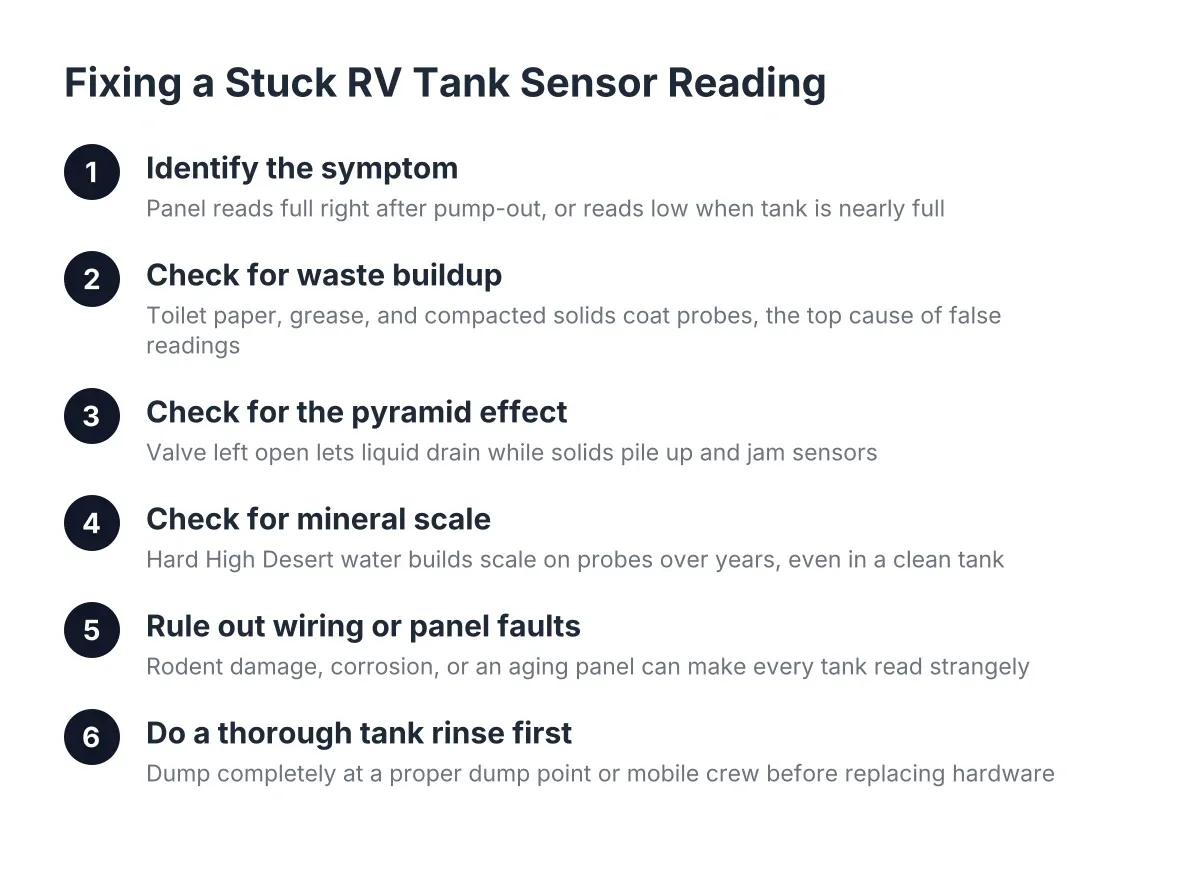
However, timing is not only about the gauge. Tank sensors in RVs are famously unreliable once waste builds up on them, so a lot of owners run on memory and guesswork. If you cannot remember the last pump-out, that is your answer. The same logic applies to cabin holding tanks: if nobody wrote down the last service date, assume you are closer to full than you think.
For context on frequency, how often you need service depends almost entirely on usage. A couple using an RV on weekends fills a black tank far slower than a family of five living in it during a remodel. Penn State Extension notes that for an active family of four on a regular septic system, pumping every two to three years is generally advisable because of higher solids and water production. A holding tank with no drain field fills many times faster than that, since nothing leaves the tank except by truck. Usage, not the calendar, sets your schedule.
Watch for these call-now signs:
- Sewage odor inside the RV or cabin that does not clear after a rinse
- Toilets that gurgle, flush slowly, or back up
- A holding tank alarm or float indicator tripping
- Visible wet spots or smells around an underground holding tank
- Any gauge reading you no longer trust before a long trip
If sewage is already backing up into a cabin or an RV, that is an emergency call, not a maintenance booking. The same local crews that handle septic backup and overflow response in Hesperia handle holding tank emergencies, and getting a truck out fast matters more than shopping three quotes.
What RV Tank Pumping Costs Near Hesperia
There is no universal price, and anyone quoting one sight unseen is guessing. Pump-out pricing is driven mostly by regional supply and demand: how many trucks operate in an area versus how many tanks need service. In a spread-out market like the High Desert, drive time is part of what you pay for, especially at remote properties.
For a rough frame of reference, Angi data puts the average cost of septic tank pumping at $427, with a range from $250 to $1,250 or more depending on tank size and location. An RV pump-out is a smaller job than a full residential septic tank, so RV service often lands below the typical septic figure, while a large cabin or campground holding tank can land within or above that range. Treat those as context, not a quote. In 2026, the honest answer to the cost of rv tank pumping near Hesperia is "it depends on volume, access, and distance," and a fair company will say exactly that, then give you a firm number once they know those three things.
The comparison that matters for planners is not pump-out versus free, it is pump-out versus the alternative. The EPA estimates septic repair or replacement typically runs $5,000 to $15,000. Holding tanks are simpler, but an overflowing tank that saturates the ground around a cabin can still mean excavation, cleanup, and inspection costs that dwarf years of routine pump-outs. Paying for scheduled RV holding tank pumping is the cheap option every time.
As for turnaround, the visit itself is quick. Pumping an RV's tanks typically takes well under an hour on site once the truck is positioned. A large cabin or campground tank takes longer, especially if the truck needs multiple disposal trips. Scheduling lead time varies by season; spring and summer travel months put more RVs on High Desert roads and more demand on local trucks, so book ahead of holiday weekends when you can.
Mobile Pump-Out vs. Dump Stations: When Each Makes Sense
Driving to a dump station is the cheapest option when it is practical. Some travelers search for free dump stations near me and plan fuel stops around them, and if your rig is road-ready and a station is on your route, that works fine.
Mobile service earns its fee when the dump station math breaks down:
- The RV is parked long-term as guest housing or a temporary residence and is not easy to move
- The rig has a mechanical issue, expired registration, or is set up on blocks and hookups
- You run a campground or host multiple rigs, and sending every guest to town is not realistic
- The property is a cabin with a fixed underground holding tank, which cannot go anywhere
- Your time is worth more than the round trip, the line, and the hose work
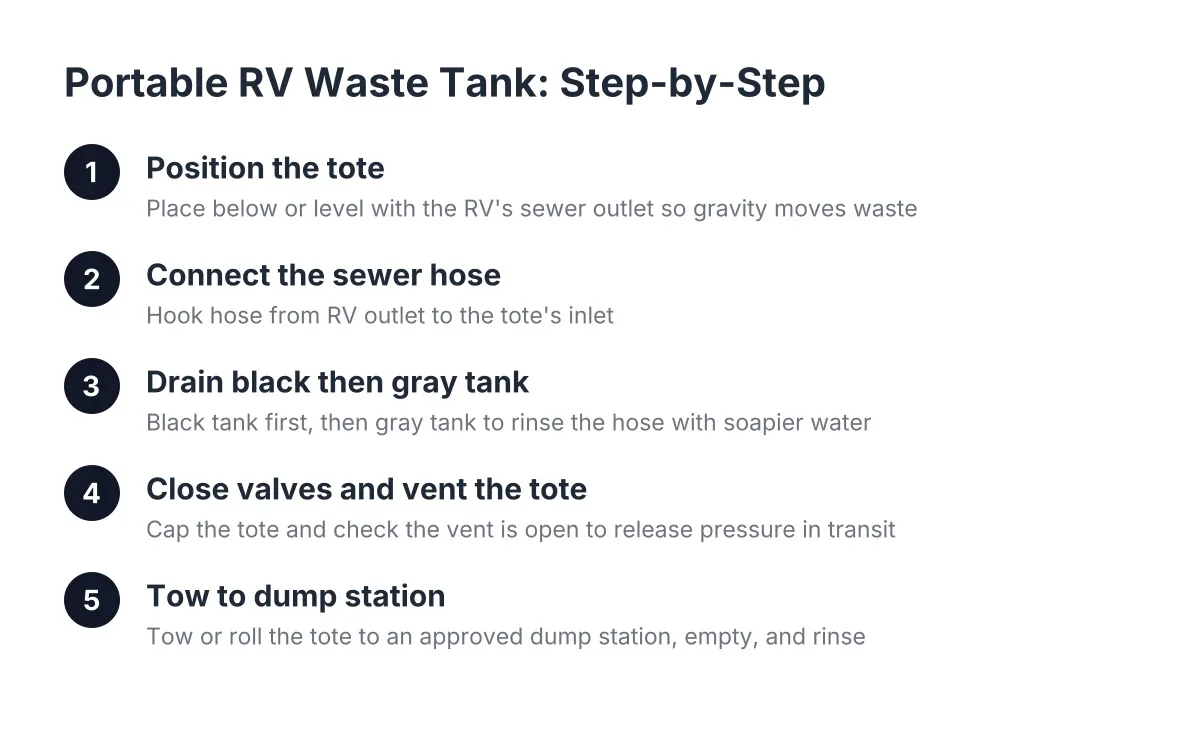
There is also a middle path: portable tote tanks you fill from the RV and wheel to a dump point. They work for small gray-water loads, but hauling a full black tank tote is heavy, unpleasant work, and it still ends at a dump station. For anything beyond occasional light use, a truck that comes to you wins on effort alone.
One honest limitation: mobile service cannot fix a tank, only empty it. If your black tank valve is seized, a sensor is dead, or an underground holding tank shows signs of cracking or leaking, pumping buys you time but the underlying problem needs a repair professional. A good pump-out tech will tell you what they see and leave the repair diagnosis to the right trade.
A Realistic High Desert Scenario
Suppose a couple in Hesperia has an in-law staying in a travel trailer on their property for three months while a room addition gets finished. The trailer is hooked to water and power, leveled on blocks, and going nowhere. Within two weeks the black tank is full, and nobody wants to re-hitch the trailer and tow it to a dump station every ten days through the whole stay.
In that scenario, the practical move is a standing mobile pump-out, say every two to three weeks depending on how the tank actually fills. The truck arrives, the tech checks the parking area, pumps the black and gray tanks, rinses, and leaves. The visit takes less time than the drive to a dump station would have. By the third visit, the homeowners know the real fill rate and can space visits to match it. No smells, no backups, no weekend lost to sewage logistics.
Swap the trailer for a hunting cabin near the foothills with a 500-gallon holding tank and the logic holds, just on a different scale. The owner books a pump-out before each season of use and one after, writes the dates on the tank lid, and never thinks about it in between. That is the whole point of a schedule: it turns a potential emergency into a line item.
How to Choose a Crew for RV Tank Pumping Near You
Pick a local, septic-focused operator who can describe the job, name where the waste goes, and quote based on your actual tank and access. Those three things separate a real hauler from a dispatch service reselling your job to whoever answers the phone.
Three questions do most of the work:
- Where does the waste go? The right answer names a licensed disposal facility or treatment plant. Vague answers are a red flag, because legal disposal is half of what you are paying for.
- Can your truck reach my site, and handle my tank in one trip? Describe your access honestly: dirt road, soft ground, gate width, distance from parking spot to tank. A good operator asks these questions before quoting. Expect the tech to walk the ground before positioning the truck, especially after rain, since a stuck pump truck ruins everyone's day.
- What is included in the price? Get clear on whether the quote covers both tanks, a rinse, disposal fees, and travel. A fair quote spells out the base service and names what would cost extra, so there are no surprises at the invoice.
Favor a crew based in Hesperia or the immediate High Desert over a call center two counties away. Local trucks know which roads wash out, which parcels have soft sand, and which disposal facilities are closest, all of which keeps your cost down and your appointment on time. A septic-focused company also tends to handle the related jobs that come up on rural properties, from septic tank pumping and inspection to locating a buried tank nobody mapped.
For context on how common these systems are, more than one in five U.S. households rely on septic or small community systems, according to the U.S. Environmental Protection Agency, while California sits at about 10 percent, among the lowest in the country. That means fewer trucks per square mile here than in septic-heavy states, which is exactly why lining up a reliable local crew before you need one pays off.
Set the Schedule Once and Stop Thinking About It
The owners who never have a sewage emergency are not lucky. They just know their fill rate and booked ahead of it. Whether you have a trailer parked for the season, a cabin holding tank, or a row of campground hookups, the move is the same: get one pump-out done, note how full the tank was, and set the next visit based on real usage instead of guesswork.
If you are in Hesperia or the surrounding High Desert and your tank is due, or you are not sure when it was last emptied, reach out to a local septic crew for a straight answer and an estimate. Describe your setup, your access, and your usage, and book the first visit. The second one goes on the calendar before the truck leaves, and the search for a pump-out service becomes a problem you solved once.
If you need your septic tank serviced, Hesperia Septic can help.
Prefer to talk it through? Call (760) 249-7872 — a quick call is usually the fastest way to get a straight answer for your situation.