Aerobic Septic System Maintenance Costs: Pumps, Filters, and Lines Explained
If your home has an aerobic septic system, maintenance is not optional. Understanding aerobic septic maintenance cost is essential since it covers more than a pump-out; it includes the aerator pump, the filters, the lines, and the chambers that make the whole treatment process work. Each of those parts can wear out, and each one carries a cost. This guide walks through what those parts do, what breaks, what upkeep tends to run, and how homeowners in Hesperia, CA can plan a schedule that keeps them off the emergency-call list entirely.
That last part matters. Most of the septic emergencies a local crew responds to, backups, odors, alarms going off at midnight, trace back to maintenance that got skipped. If you just bought a house on septic and you are not sure when the tank was last pumped, this article is written for you.
How an Aerobic Septic System Works, in Plain Terms
A conventional septic system has two main components: a tank that clarifies wastewater and a drain field that disperses the clarified liquid into the soil, according to the U.S. Environmental Protection Agency. All your household drains feed one pipe into the tank. Solids settle out, and the liquid flows on to the drain field through perforated pipes surrounded by gravel.
An aerobic system adds machinery to that basic design. A typical aerobic setup runs in four stages: a primary tank where solids settle, an aeration chamber where air is pumped in to feed bacteria that break down waste, a clarifier chamber where remaining particles settle, and a pump tank that sends the treated water out. Some systems have extra chambers depending on how they were built.
The key difference from a gravity system is the mechanical parts. A control box houses an aerator pump that pushes air through a line into the treatment tank. Many systems also have a discharge pump, float switches, and an alarm. Every one of those parts has a working life, and every one of them costs money to replace when it fails. That is why aerobic septic system maintenance costs more over time than upkeep on a simple gravity tank.
What Aerobic Septic System Maintenance Actually Includes
Aerobic septic system maintenance includes periodic pumping of the tanks, cleaning or replacing filters, checking the aerator and discharge pumps, testing float switches and the alarm, and inspecting the lines that carry air and water between chambers. A full service visit covers all of it, not just the pump-out. Skipping any one piece shortens the life of the others.
Here is what each part of a service visit involves:
- Pumping the tanks. Solids build up in the primary tank the same way they do in any septic tank. Pumping removes them before they flow forward and clog the aeration chamber, the filters, or the drain lines. Pumped waste gets trucked to a sewage treatment plant for disposal; it is not processed on-site, according to the New Hampshire Department of Environmental Services.
- Cleaning or replacing filters. Filters catch particles before water leaves the system. A dirty filter slows flow, raises water levels, and can trigger the alarm. Cleaning is routine; replacement happens when a filter is damaged or past its useful life.
- Checking the aerator pump. This is the heart of the system. If the aerator quits, the bacteria that do the treatment work start dying off, and the system slides toward failure. A technician checks that it runs, that the air line is intact, and that air is actually reaching the chamber.
- Testing floats and the alarm. Broken float switches are one of the most common problems found on service calls. A float that sticks or fails can let the pump run dry, let the tank overfill, or leave you with no warning before a backup.
- Inspecting lines. Air lines crack, discharge lines clog, and lateral lines in the disposal area can get root intrusion or damage. Catching a cracked line early is a cheap fix; finding it after the yard smells is not.
Some aerobic systems are also designed to use chlorine tablets for disinfection before discharge. If yours is one of them, keeping the chlorinator stocked with the correct septic-rated tablets is part of the routine. Never substitute pool chlorine tablets; they are chemically different and can be dangerous in a septic chlorinator.
What Aerobic Septic System Maintenance Costs: Pumps, Filters, and Lines
There is no single national price, and anyone who quotes you a flat number without seeing your system is guessing. That said, the cost picture breaks into three layers, and understanding them makes quotes much easier to compare.
Layer one: routine pumping
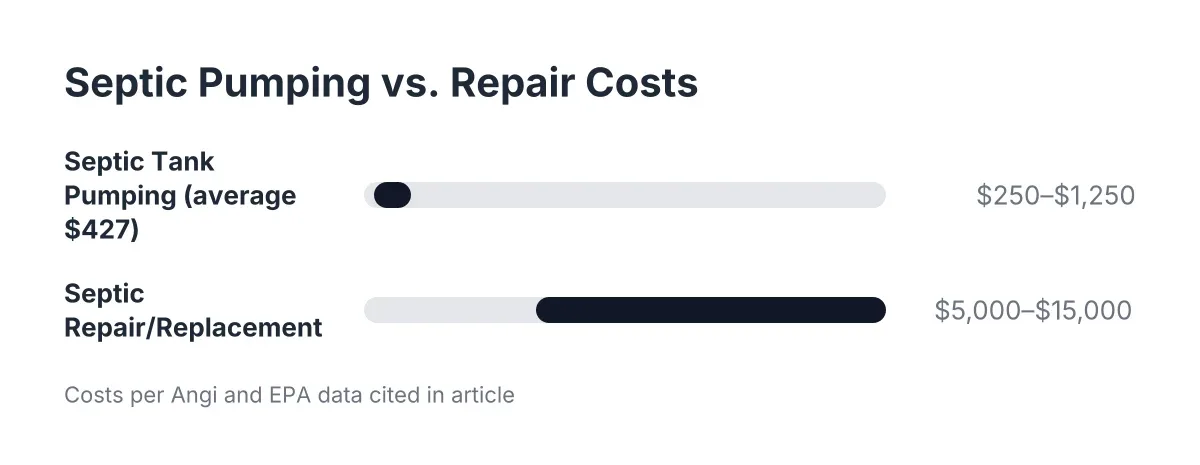
Pumping is the baseline cost for any septic system, aerobic or not. According to Angi data, septic tank pumping averages $427, with a range from $250 to $1,250 or more depending on tank size and location. Aerobic systems can land higher in that range when multiple chambers need pumping on the same visit, since there is simply more volume and more access points involved.
Layer two: inspections and routine service visits
Aerobic systems need professional eyes on them more often than gravity systems. The EPA recommends that alternative systems with electrical float switches, pumps, or mechanical components be inspected once a year. Compare that to a standard gravity system, which the EPA says the average household should have inspected at least once every three years. A routine aerobic service visit, where a technician checks pumps, floats, filters, and lines, is a smaller cost than pumping, but it recurs more often. In many areas, homeowners handle this through an ongoing maintenance arrangement rather than one-off calls, which keeps the schedule from slipping.
Layer three: parts that wear out
This is the layer that surprises people. As an illustrative estimate, an aerator pump replacement commonly runs several hundred dollars installed, and a discharge pump falls in a similar range. Float switches and filters are cheaper individually but add up when neglect forces frequent replacement. Line repairs vary the most; a cracked air line near the control box is a quick fix, while a damaged or clogged lateral line in the disposal area can require digging.
The honest math is this: neglect does not save money, it moves the cost to a worse column. Skipped maintenance means more frequent pump-outs, earlier pump and filter replacement, and a shorter life for the whole system. The EPA estimates septic repair or replacement typically costs between $5,000 and $15,000, far more than routine pumping. A year of diligent upkeep costs a fraction of one failed system.
A Realistic Aerobic Septic Maintenance Schedule for Cost Control
A workable aerobic septic system maintenance schedule has three rhythms: what you watch monthly, what a professional checks yearly, and what gets pumped on a multi-year cycle. Put the first on your phone calendar, the second on a standing appointment, and ask your pumper to tell you the right interval for the third based on your actual sludge levels.
Here is a schedule most homeowners can live with:
- Monthly, on your own: Walk past the system. Listen for the aerator hum, look for standing water or soggy spots over the tanks or disposal area, and note any odor. If your system uses chlorine tablets, check the supply. Confirm the alarm light is off.
- Yearly, by a professional: Full inspection of pumps, floats, filters, lines, and the control box, per the EPA's once-a-year guidance for systems with mechanical components. This is where small problems get caught while they are still cheap.
- Every few years, pumping: Frequency depends on household size and usage. As a reference point, Penn State Extension notes that for an active family of four, pumping every two to three years is generally advisable because of the higher solids and liquid load. Your interval may differ; measured sludge depth beats any rule of thumb.
The purpose of this rhythm is threefold: prevent problems before they start, catch the ones already developing, and extend the working life of a system that costs five figures to replace. Homeowners who keep this schedule are the ones who never end up searching for emergency septic pumping at 9 p.m. on a Sunday.
What You Can Do Between Service Visits
Daily habits decide how hard your system has to work. The bacteria in the aeration chamber are a living ecosystem, and the fastest way to raise your maintenance costs is to poison them or drown them.
Keep these out of your drains:
- Grease, fats, and cooking oil
- Wipes of any kind, including ones labeled flushable
- Paint, solvents, harsh drain cleaners, and large amounts of bleach
- Coffee grounds, eggshells, and heavy garbage disposal use
- Medications, which can kill the bacteria doing the treatment work
Water load matters just as much as what goes down the drain. Hydro overloading, meaning more water entering the system than it can process, is one of the most common causes of high water alarms and backups. A single leaky or running toilet can add as much as 200 gallons of extra water per day to a septic system, according to the U.S. Environmental Protection Agency. Fix running toilets fast, spread laundry across the week instead of doing six loads on Saturday, and keep roof drains and sprinklers pointed away from the tanks and disposal area.
Protect the hardware too. Never drive or park over the tanks, the lines, or the disposal area. Keep trees and deep-rooted shrubs away from lateral lines. If you are not sure where everything is buried, a septic tank locating visit solves that once, and the map pays for itself every time work needs to be done.
One more note on shortcuts: additive and enzyme products get marketed hard to septic owners, but regular pumping and professional inspection do far more to prevent problems than anything poured down a drain. A healthy system does not need additives, and no additive rescues a neglected one.
Warning Signs That Mean Call Someone Now
Aerobic systems usually give warning before they fail outright. Acting on the first sign is the difference between a service call and a sewage cleanup.
Watch for these:
- The alarm light or buzzer is on
- The aerator has gone silent
- Drains are slow throughout the whole house, not just one fixture
- Sewage odor inside, near the tanks, or over the disposal area
- Wet, spongy, or unusually green patches of lawn over the system
- Gurgling sounds from drains or toilets
Suppose a homeowner in Hesperia, CA notices the system alarm chirping on a Thursday and silences it, figuring it is a glitch. By Sunday the master bathroom shower is backing up, and by Monday there is sewage in the tub. In that scenario, what started as a stuck float switch, a modest fix on a routine visit, has become an emergency pumping call plus cleanup inside the house. The alarm existed to prevent exactly that chain of events.
If any of these signs show up, stop running water as much as you can and get a professional out. Diagnosing an aerobic system involves electrical components and sewage; it is not a weekend DIY project, and misdiagnosing a pump or line problem usually makes the repair more expensive.
Finding Aerobic Septic System Service in Hesperia, CA
Not every pumping outfit services aerobic systems, so ask directly before you book. A gravity-tank pump-out and a four-chamber aerobic service call are different jobs, and you want a crew that knows the difference. High Desert conditions add their own wrinkles; dry, compacted soil and hot summers are hard on buried lines and on pumps that run constantly.
When you compare local providers in 2026, a few questions cut through the noise:
- Do you service aerobic systems, or only pump conventional tanks?
- What does your routine visit include? Pumping only, or pumps, floats, filters, and lines?
- Will you tell me my measured sludge level and recommend an interval based on it, rather than a one-size schedule?
- Can you locate my tanks and lines and give me a record for next time?
- What happens if you find a problem? Do I get a plain explanation before any extra work?
That last question addresses a fair worry. Plenty of homeowners put off scheduling because they fear a company will invent problems to pad the bill. A straightforward operator shows you what they found, explains why it matters, and lets the evidence speak. On an aerobic system, most findings are visible or audible: a pump that does not run, a filter caked solid, a float that does not trip. You should be able to see what you are paying to fix.
One trade-off worth stating plainly: if you are choosing between system types on a new build or replacement, know that aerobic systems carry a permanently higher maintenance load than conventional gravity systems. A well-maintained gravity system can serve a long time without mechanical parts to replace. Soil conditions and local rules decide which type your property needs, and that is a conversation for a licensed installer, since system design involves soil type, percolation rates, and local regulations, as the New Hampshire Department of Environmental Services notes.
The Bottom Line for Hesperia Homeowners
Aerobic septic system maintenance has three cost layers: pumping on a multi-year cycle, a yearly professional inspection, and the occasional pump, filter, or line replacement as parts age. Budget for all three and none of them will hurt. Skip them and the costs do not disappear; they compound into emergency calls and, eventually, a repair bill the EPA pegs at $5,000 to $15,000.
The homeowners who never have a septic disaster are not lucky. They treat septic tank maintenance like an appointment, not a reaction. They know where their tanks are, they know when they were last pumped, and they have a local crew they can call before the alarm ever sounds. If you are new to a septic home in Hesperia, CA, the single best move you can make this month is to schedule an inspection, learn what shape your system is in, and put the next pumping date on the calendar before you need it.
If you need your septic tank serviced, Hesperia Septic can help.
Prefer to talk it through? Call (760) 249-7872 — a quick call is usually the fastest way to get a straight answer for your situation.