How a Septic Maintenance Schedule Prevents Emergency Backups in Hesperia, CA
If sewage is backing up right now, stop running water, keep everyone away from the affected drains, and call a local septic crew. That is the short answer for a crisis. The longer answer, and the one that matters more once the mess is cleaned up, is that a real septic maintenance schedule prevents most of these emergencies from ever happening. Most late-night backup calls trace back to a tank that went years past its pumping interval, not to bad luck. This guide covers both sides: what to do tonight if your system is failing, and how to set up a schedule so you are not making that call again.
This is written for two kinds of readers in Hesperia. The first is a homeowner who just watched a drain back up. The second is a landlord, restaurant manager, or property owner who got the call from a tenant or a health inspector and needs the problem handled without being on-site. Both end up in the same place: a plan that keeps the tank pumped before it fails.
What to Do Right Now if Sewage Is Backing Up
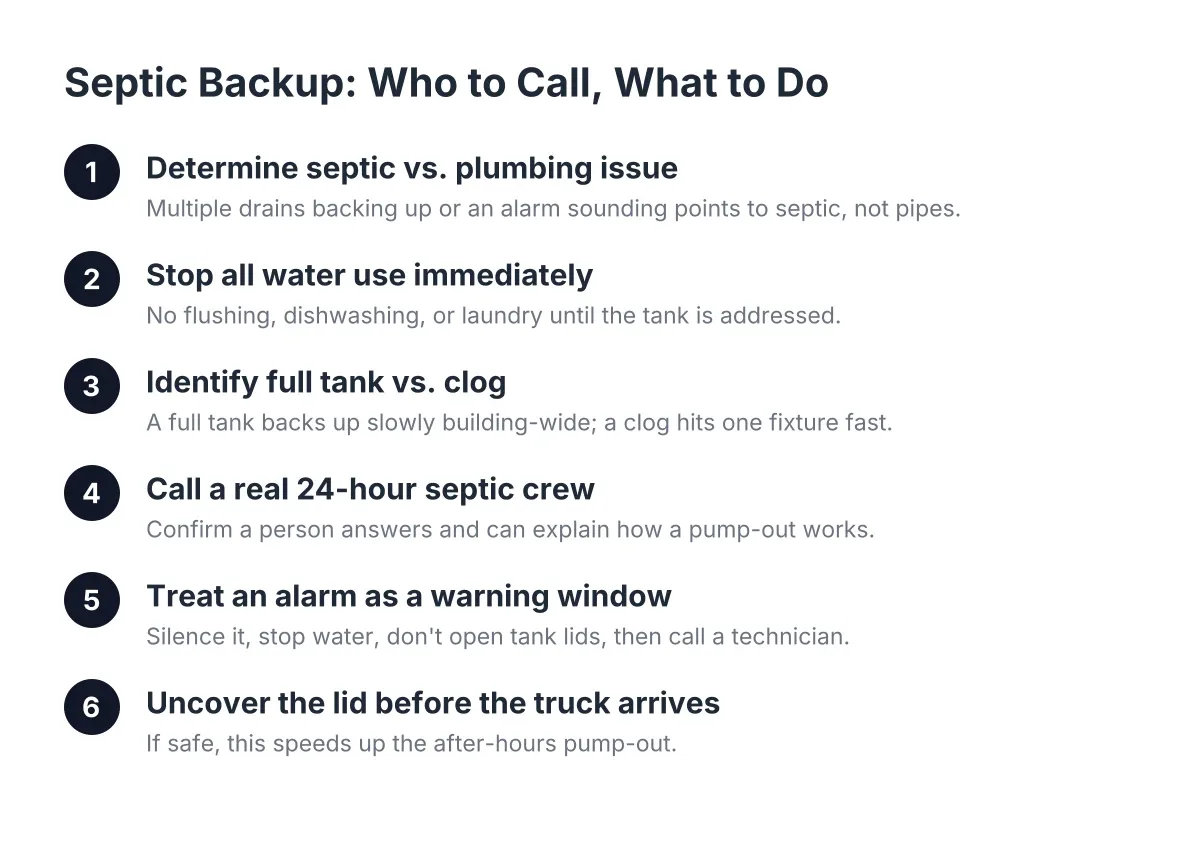
If sewage is actively backing up into a house or building on a septic system, the first move is to stop adding water. Every flush, load of laundry, or running faucet pushes more wastewater into a tank that has nowhere to put it. Cutting water use buys you time and limits the damage while help is on the way.
Here is the order of operations while you wait for a crew:
- Stop all water use in the building. No flushing, no showers, no dishwasher, no laundry.
- Keep people and pets away from any standing sewage, indoors or in the yard. Raw sewage carries bacteria and is a health hazard.
- If the backup is indoors, open windows for ventilation and move anything salvageable out of the affected area.
- Do not open the septic tank lid yourself. Tank gases are dangerous, and an open tank is a fall hazard.
- Note what you saw and when: which drains backed up first, any gurgling, any smell outside, whether an alarm is sounding.
- Call a local septic company and describe exactly what is happening.
That last step matters more than most people expect. A crew that knows you have sewage in a hall bathroom, a gurgling floor drain, and a wet patch over the tank can show up with the right expectations. Vague calls get slower, messier visits.
One honest caveat: not every backup is the septic system. A clog in the line between the house and the tank can look identical from inside the building. A clogged inlet baffle is a common cause of septic backups and one of the first things to check when a line into the tank is blocked, according to the Washington State Department of Health. Additionally, a professional can tell the difference on-site; guessing from the bathroom cannot.
Why the Septic Alarm Is Going Off, and What It Means
A septic alarm going off means the water level in your tank or pump chamber is higher than it should be. It does not mean sewage is about to erupt in the next five minutes, but it does mean the system needs attention soon, usually within a day. Treat it as a warning shot, not a false alarm.
First, silence the alarm if there is a silence button, but do not disconnect power to the system. Then cut back water use hard, the same as you would in an active backup. In many cases the high level came from a surge: a houseful of guests, back-to-back laundry loads, or a fixture leak. According to the U.S. Environmental Protection Agency, a single leaky or running toilet can push as much as 200 gallons of extra water per day into a septic system. That alone can trip an alarm on a system that was otherwise fine.
However, if the alarm keeps sounding after you have cut water use for several hours, assume something failed: a pump, a float switch, or a tank that is simply full. Systems with pumps and float switches need more attention than gravity systems in general. The EPA recommends that alternative systems with electrical floats, pumps, or mechanical components be inspected about once a year, compared with at least once every three years for a standard system.
How to Build a Septic Maintenance Schedule and Prevent Emergencies
A septic maintenance schedule prevents emergencies by removing the root cause before it becomes a crisis. Backups almost never come out of nowhere. Sludge settles at the bottom of the tank and scum floats at the top, year after year. When those layers get thick enough, solids push into the outlet and toward the drain field, and the system stops accepting water. The backup you see on a Saturday night was building for years.
A conventional system has two main parts, the septic tank and the drain field, as the U.S. Environmental Protection Agency describes it. The tank exists to hold solids back so only liquid moves on to the drain field. Once solids escape the tank, the drain field starts to clog, and that is the failure that gets expensive. Pumping on schedule is what keeps solids where they belong.
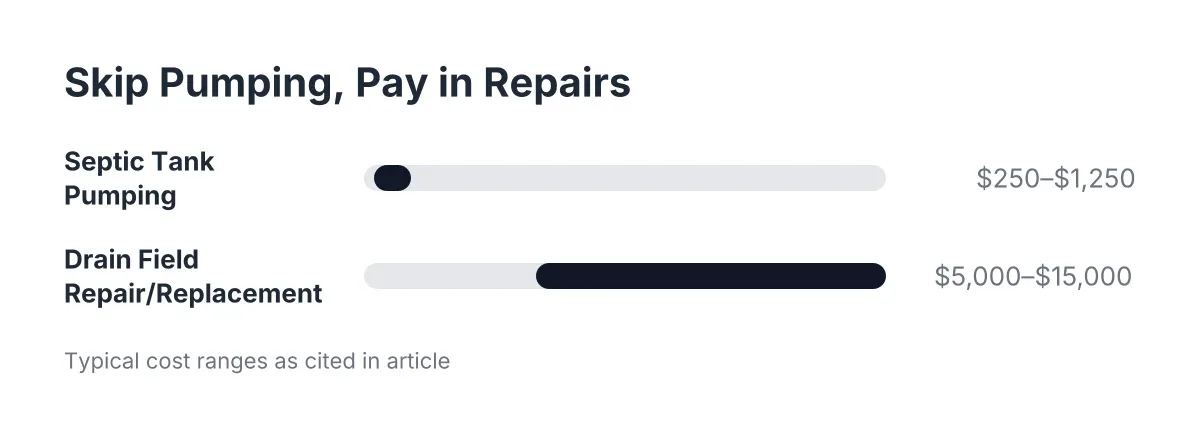
The math is lopsided. According to Angi data, septic tank pumping averages $427, with a typical range of $250 to $1,250 depending on tank size and location. Compare that with what happens when a drain field fails: the EPA estimates septic repair or replacement typically runs $5,000 to $15,000. A maintenance schedule is the cheapest insurance a septic owner can buy, and it is not close.
There is also a compounding effect that owners rarely see coming. A neglected system does not just risk one big failure. It burns through filters and pumps faster, needs pump-outs more often once problems start, and turns every small issue into a service call. Regular pumping and periodic professional inspection beat additives and quick fixes every time; the tank is a biological system, and there is no product you pour down a drain that removes accumulated sludge.
What a Realistic Schedule Looks Like
The EPA baseline is a professional inspection at least once every three years for a standard household system. Pumping frequency depends on tank size, household size, and water habits. Penn State Extension notes that an active family of four generally does well pumping every two to three years because of the higher volume of solids and wastewater they produce. A retired couple in the same house might stretch that interval; a rental with six tenants might shorten it.
For Hesperia properties, a workable 2026 schedule looks like this:
- Standard residential system: professional inspection every three years at minimum, pumping on the interval your pumper recommends based on measured sludge levels.
- Busy household of four or more: plan on pumping roughly every two to three years, per the Penn State Extension guidance.
- System with a pump, float switch, or aerobic components: annual inspection, per EPA guidance, plus whatever the maintenance agreement on an advanced treatment system requires. If your system came with a service contract, follow it.
- Rental property: inspection when tenants turn over, plus the regular pumping interval. Tenants rarely report early warning signs.
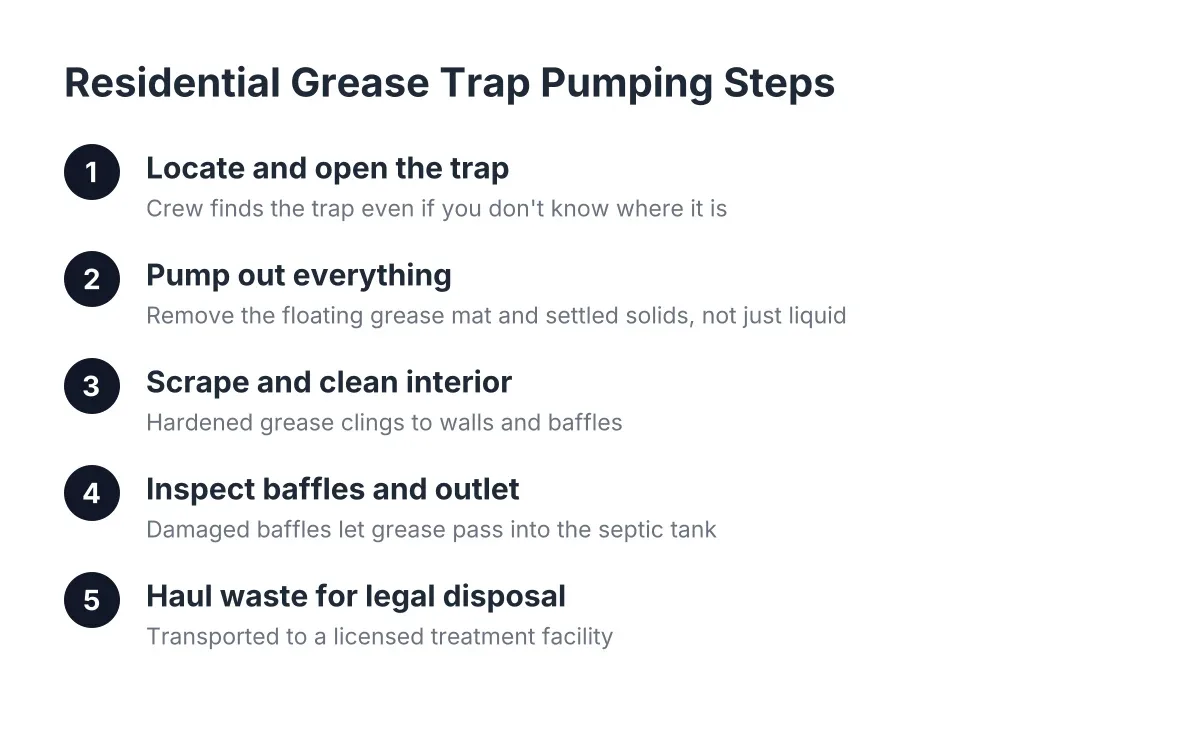
- Commercial grease trap: pumping on the interval your health inspector expects, tracked in writing.
The honest trade-off is that a schedule means paying for service when nothing is visibly wrong. That is exactly the point. Septic problems develop gradually and silently; by the time you can see or smell one, the cheap fix window has usually closed.
The Warning Signs a Schedule Catches Early
Between scheduled visits, certain symptoms mean the system is asking for help. None of them are emergencies yet, and that is the value of catching them now instead of in six months.
- Drains throughout the building run slow, not just one fixture.
- Gurgling from toilets or drains when other fixtures run.
- Sewage odor in the yard, near the tank, or inside the building.
- Unusually green or soggy grass over the drain field.
- Standing water or wet soil near the tank lids.
- Any septic alarm activation, even one that stops on its own.
For example, one slow bathroom sink is probably a hair clog. Every drain in the house running slow at the same time points at the tank or the line to it. That distinction is worth remembering because it determines whether you need a drain snake or septic tank pumping.
When a scheduled inspection catches a rising sludge level or a worn baffle, the fix is a routine visit at a routine price. When a backup catches it for you, the fix involves after-hours rates, cleanup, and sometimes a drain field that took damage. The whole argument for maintenance fits in that comparison.
Landlords, Restaurants, and RV Owners: Scheduled Service Without Babysitting It
Non-residential septic service runs on the same principle as residential: a schedule prevents the fire drill. The difference is that landlords, restaurant managers, and RV owners usually cannot be on-site, and the consequences of a failure include health code citations and habitability complaints, not just a bad weekend.
Suppose you manage a rental in Hesperia and a tenant texts about a sewage smell in the yard. Without a service history, you are starting from zero: no idea where the tank is, when it was last pumped, or whether this is a full tank or a failing drain field. With a pumping record and a known tank location, one phone call gets a crew out, and you handle the whole thing remotely. That is the practical payoff of a schedule for an owner who is not on the property.
Restaurants and commercial kitchens carry an extra layer. A grease trap that misses its pumping interval does not just risk a backup; it risks an inspector flagging it. Keeping grease trap pumping on a fixed calendar, with dated service records, turns a compliance risk into a filing task. Ask your pumper for documentation of each visit, since proof of proper waste handling is what an inspector or a lawyer will eventually want to see.
RV and holding tank owners in the High Desert face a simpler version of the same problem: a holding tank has no drain field, so it fills on a predictable clock. Scheduling a pump-out before a trip, or on a set interval for a cabin, beats discovering a full tank when guests arrive. The pattern is identical across all of these cases. One local crew, one recurring schedule, no fire drills.
When It Fails Anyway: What Emergency Septic Service Looks Like
Even well-maintained systems can fail. Tree roots invade lines, baffles crack, pumps burn out, and heavy winter rains can saturate a drain field that was working fine in September. When that happens, emergency septic service exists to stop the immediate problem: a crew comes out, locates and opens the tank, pumps it down to relieve pressure on the system, and assesses what actually failed. Pumping the tank resolves many backups on the spot; if the drain field or a component failed, at least the sewage stops rising while you plan the repair.
Here is an illustrative scenario. Say a Hesperia homeowner notices the master bathroom toilet gurgling on a Friday, ignores it, and wakes Sunday to sewage in the shower pan. In that scenario, the emergency visit involves after-hours pumping, indoor cleanup, and possibly a follow-up dig to inspect the baffles. Now run the same scenario with a maintenance schedule: an inspection eighteen months earlier flags a sludge layer near the outlet, the tank gets pumped that week, and the Sunday backup never happens. Same house, same system, entirely different weekend and bill.
There are limits to what any article can diagnose. If your system is backing up repeatedly despite recent pumping, if sewage is surfacing over the drain field, or if you suspect a collapsed line, you need a professional on-site, and possibly an evaluation of the drain field itself. Repeat failures usually mean something structural, and no schedule fixes a broken component.
Setting Up Your Schedule This Week
Getting from reactive to scheduled takes one service visit and about twenty minutes of record-keeping. Here is the sequence for a Hesperia property owner starting from scratch in 2026:
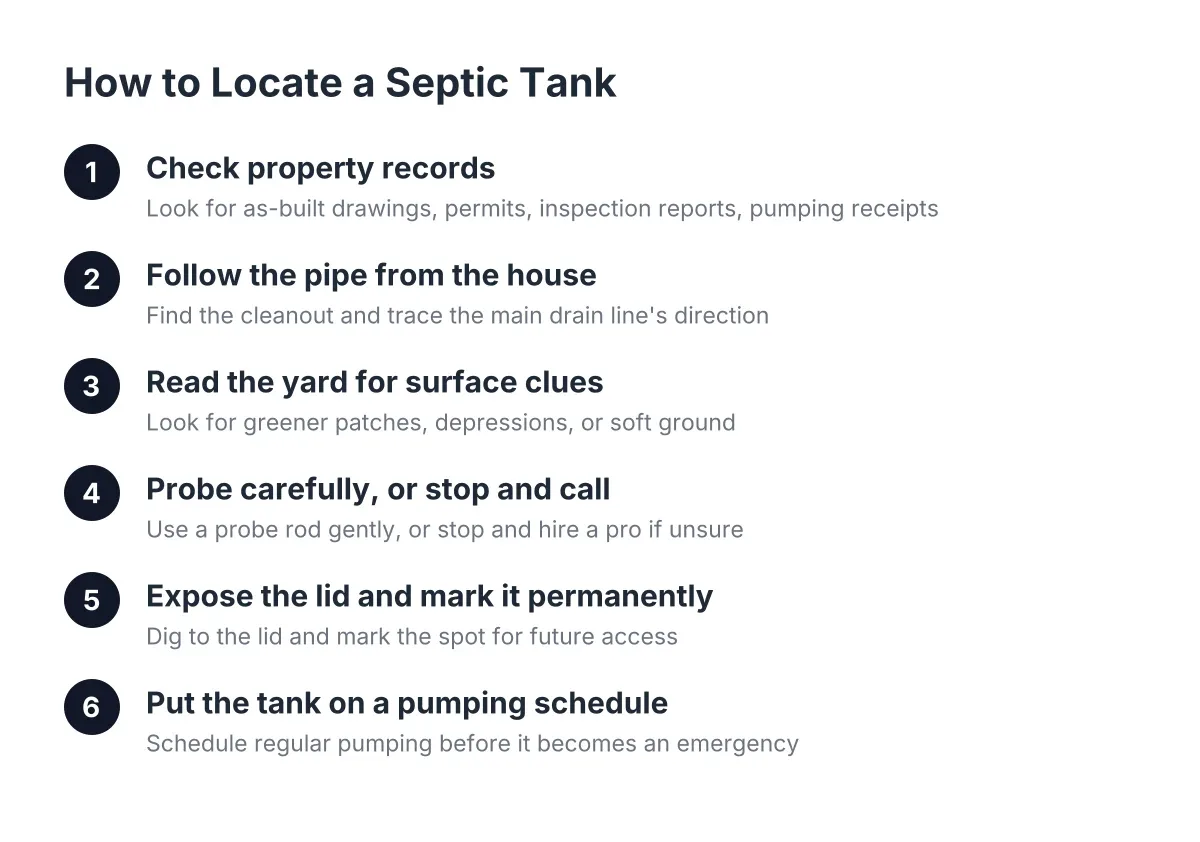
- Find out where your tank is. If you do not know, a septic company can locate it; many owners of older High Desert properties have never seen their lids.
- Get the tank pumped and inspected in the same visit. Ask the crew to note the sludge level, the tank's apparent condition, and anything that needs attention.
- Write down the date, what was done, and the recommended interval. Keep it with your home or property records.
- Put the next inspection on your calendar now. Three years out for a standard system, one year for anything with a pump or floats.
- Fix water leaks promptly. A running toilet quietly overloads the tank, and it shortens every interval you just set.
- For rentals and commercial properties, tell your pumper you want recurring service, so the reminder comes from them, not from a tenant complaint.
None of this is complicated, which is why it is easy to postpone. A septic maintenance schedule prevents the two outcomes every septic owner dreads: sewage in the building, and a five-figure drain field replacement. The system under your yard fails slowly and then suddenly. A calendar reminder and a pumping visit every few years is what keeps the sudden part from happening at your property.
If you need your septic tank serviced, Hesperia Septic can help.
Prefer to talk it through? Call (760) 249-7872 — a quick call is usually the fastest way to get a straight answer for your situation.