Black Tank vs. Gray Tank: RV Holding Tank Differences That Matter at Pump-Out Time
If you own an RV, run a small campground, or keep a cabin in the High Desert, you deal with two kinds of waste water, and they do not behave the same. Your RV holding tank setup almost always includes a black water tank and a gray water tank, and knowing the difference changes how you use them, how often you need a pump-out, and what a mobile service crew actually does when the truck shows up. This guide walks through both tanks, side by side, with the details that matter for RV owners and property operators around Hesperia who need someone local to handle the mess.
Plenty of pages online will sell you a replacement tank or a treatment chemical. That is not this article. This is about the service side: what each tank holds, why the black tank causes most of the emergencies, and how to get a mobile pump-out at an RV pad, a campground, or a remote cabin that other crews skip because it sits too far off the pavement.
The Two Tanks in Every RV Holding Tank System
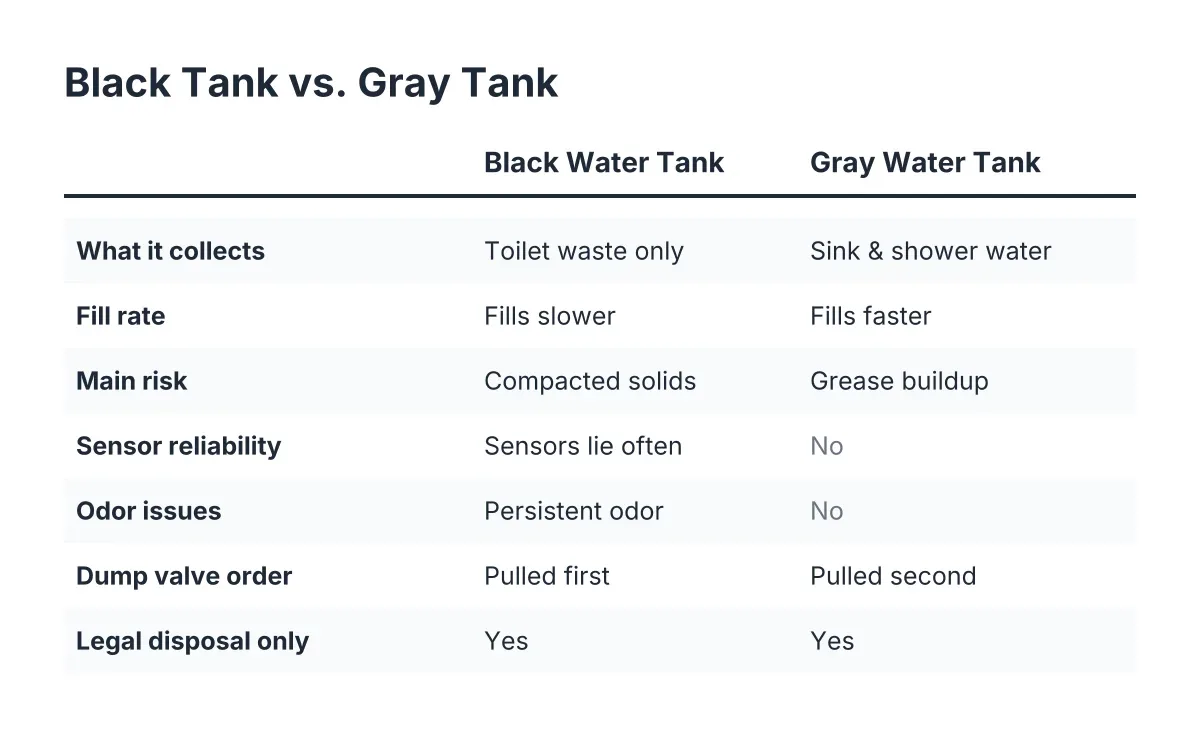
An RV holding tank system splits waste into two separate tanks. The black water tank collects everything from the toilet, meaning sewage and toilet paper. The gray water tank collects everything else, meaning water from the shower, the bathroom sink, and the kitchen sink. They fill at different rates, smell different, and carry different risks when they back up.
Most RVs also carry a third tank for fresh water, but that one holds clean water for drinking and washing. It never gets pumped by a waste service. When people search for RV tank pumping service near me, they are almost always dealing with the black tank, the gray tank, or both.
Here is the short version of how the two waste tanks compare:
- Black water tank: Toilet waste only. Smaller in many rigs, fills slower by volume but causes bigger problems. Solids can compact if the tank sits too long or gets dumped wrong.
- Gray water tank: Sink and shower water. Often fills faster because showers and dishwashing use a lot of water. Carries grease, soap scum, food particles, and hair.
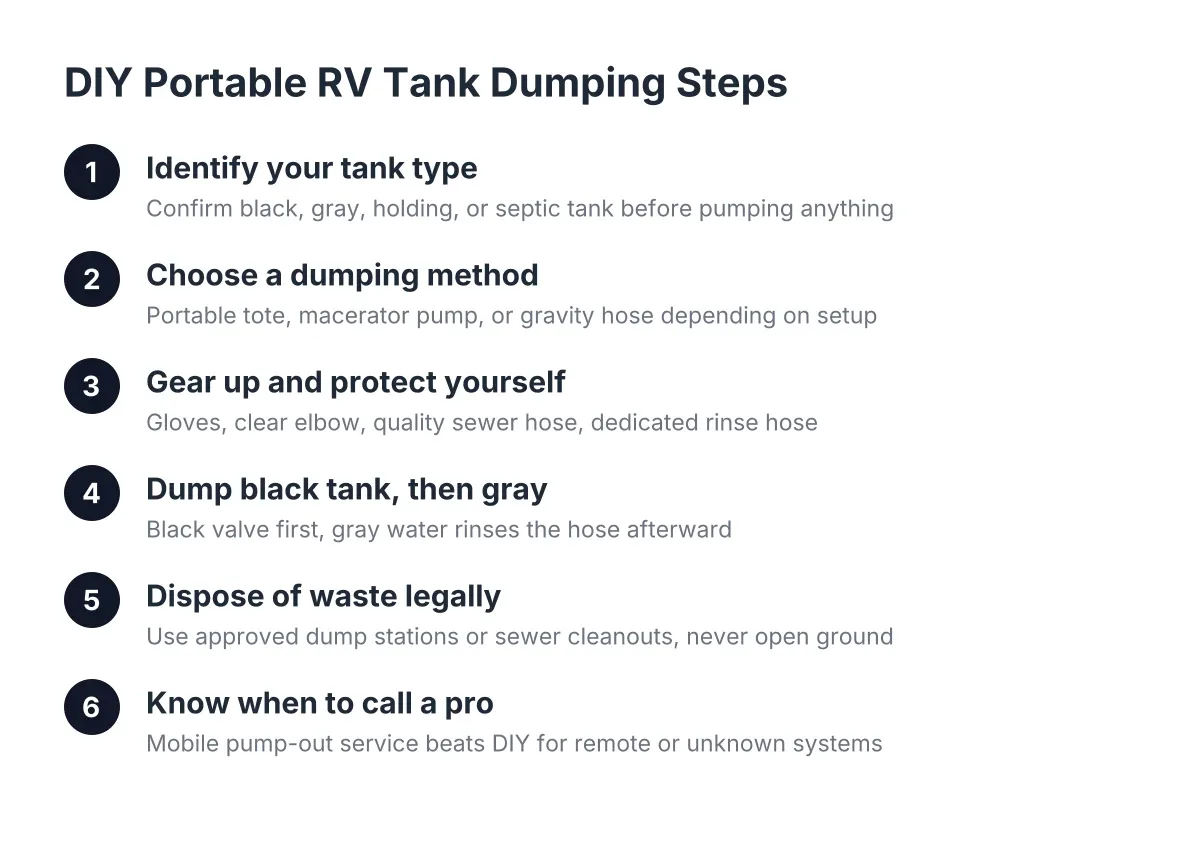
- Valves: Each tank has its own dump valve, usually side by side near the sewer outlet. The black valve gets pulled first at dump time, then the gray, so the gray water rinses the hose.
That last point matters more than most new owners realize. Pull the valves in the wrong order and you rinse your sewer hose with sewage instead of soapy sink water.
Why the Camper Black Water Tank Causes Most Service Calls
The black tank is where things go wrong. Gray water is unpleasant, but a camper black water tank holds raw sewage, and sewage does not forgive neglect. Three problems drive most of the service calls we see in the High Desert.
Compacted solids and the dreaded pyramid
If you leave the black valve open at a full-hookup site, liquid drains out constantly while solids stay behind. Over weeks, those solids build into a hard pile under the toilet drop. RV owners call it the pyramid of doom, and once it forms, a normal dump will not clear it. The tank needs a proper pump-out with rinsing, and sometimes repeated flushing, to break it up.
Heat makes this worse. High Desert summers bake the contents of a parked rig. A trailer that sat at a Hesperia property through July with a half-full black tank can turn into a solid problem by September.
Sensors that lie
RV holding tank sensors read full when the tank is nowhere near full because waste and paper cling to the sensor probes. Owners then dump constantly, or worse, they stop trusting the gauge entirely and get surprised by an actual full tank. A thorough pump-out with a rinse helps clear sensor buildup, though stubborn sensors sometimes need a dedicated tank rinser or cleaner to read right again.
Odor that will not quit
A black tank that never gets fully emptied and rinsed develops a smell that treatment chemicals and deodorizer packets only mask. Treatments help break down waste between dumps, and they are worth using. However, they are not a substitute for actually getting the contents out of the tank.
What the Gray Water Tank Does Differently
Gray water sounds harmless compared to sewage, but it creates its own service problems, especially for the commercial side of this business. Kitchen sink water carries grease, and grease does in a gray tank exactly what it does in a restaurant grease trap: it cools, hardens, and coats everything.
For an RV park or campground operator, gray water volume is the bigger planning issue. Guests shower daily and wash dishes constantly, so gray tanks and gray water holding systems fill faster than black tanks. A park with a central holding tank collecting gray water from multiple sites needs scheduled pumping, not crisis pumping. The math is the same as a restaurant grease trap on a monthly or quarterly route: a reliable recurring vendor beats an emergency call every time.
For individual RV owners, the practical difference shows up at the dump station or during a mobile pump-out. Gray water can legally go only where sewage goes, into an approved dump point or a service truck. Dumping gray water on the ground is illegal in California, even though it looks like dishwater. Do not let the mild appearance fool you into a fine.
When to Pump an RV Holding Tank Instead of Dumping It Yourself
Call a mobile pump-out service when the rig cannot move, the tank has a problem a dump station cannot fix, or the property has no dump access. If your RV sits parked long-term on a Hesperia lot, has compacted solids, a stuck valve, or a failed sensor reading, a service truck coming to you beats towing the rig to a station.
Plenty of RV owners handle routine dumps themselves at a station, and that is fine. The mobile service call makes sense in specific situations:
- The rig is parked long-term. A trailer used as a guest room or job-site quarters on a rural property fills its tanks without ever moving. Someone has to come to it.
- The black tank is compacted. A dump station drains liquid; it does not break up a solid pile. A pump truck with rinse capability can.
- You are prepping for a trip or storage. Leaving a black tank full through winter storage, or starting a long trip with tanks near capacity, invites exactly the problems described above.
- A valve failed. A stuck or broken RV holding tank valve means you cannot dump normally. A crew can often pump the tank through the top or work around the valve until you get a repair kit installed.
- The property is remote. Cabins and off-grid parcels around the High Desert often use holding tanks with no septic system at all. Those tanks have to be pumped on a schedule, full stop.
Suppose a homeowner outside Hesperia keeps a travel trailer on the property for a relative, hooked to power and water but with no sewer connection. The tanks fill every couple of weeks depending on use. In that scenario, a recurring mobile pump-out visit is not a luxury; it is the only sanitation plan the setup has. The same logic applies to a small campground owner with a dozen sites and a shared holding tank, where a missed pump-out means closed restrooms and unhappy guests.
How a Mobile RV Holding Tank Pump-Out Works
A mobile RV holding tank pump-out is straightforward: a vacuum truck comes to your rig or property, connects a hose to the tank outlet, and pumps the contents into the truck for legal disposal. The whole visit for a standard RV usually takes well under an hour once the truck is positioned.
Here is what a typical visit looks like, step by step:
First, the crew locates the outlet. On an RV, that is the sewer connection where the black and gray valves sit. On a cabin or campground holding tank, it may be a buried access lid, which is why tank locating is sometimes part of the job on older properties.
Next, the crew connects the vacuum hose and pumps the black tank first, then the gray. Pulling the black tank first means the gray water helps rinse the line, the same order you would use at a dump station.
Then comes rinsing, if the tank needs it. Compacted solids, sensor buildup, and odor problems call for adding water and pumping again, sometimes more than once. This is the part a self-service dump cannot replicate, and it is where RV holding tank pumping earns its keep over a quick drain-and-go.
Finally, the waste leaves in the truck for disposal at an approved facility. That matters in the High Desert, where the nearest legal dump point can be a long drive from a rural parcel. You are paying for the pumping and for the legal hauling, not just the vacuum.
One honest limitation: a pump-out fixes a full or fouled tank, but it does not fix a cracked tank, a failed valve, or a plumbing leak inside the rig. If the crew finds physical damage, tank repair or replacement is a separate job, often for an RV shop. A good service will tell you that plainly instead of pretending a pump solves everything.
How Often to Pump RV Holding Tanks
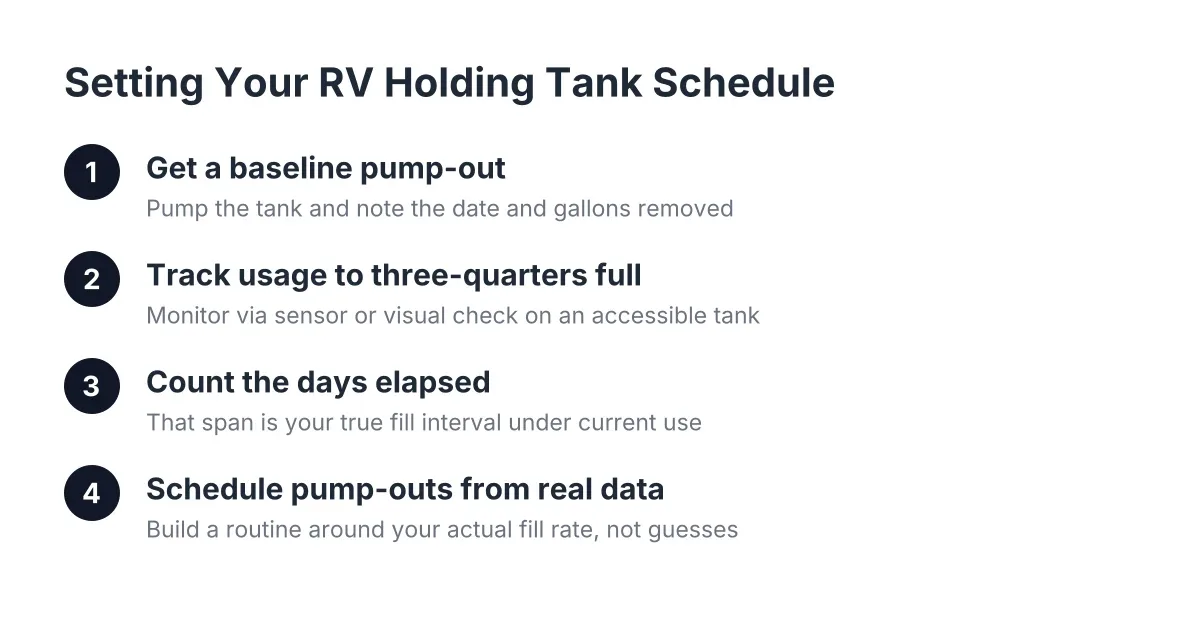
How often to pump RV holding tanks depends on tank size, how many people use the rig, and whether it moves. A couple traveling in a motorhome might dump every three to five days on the road. A parked trailer housing two people full-time may need service every one to two weeks. Additionally, a seasonal cabin holding tank might go on a monthly or quarterly schedule.
The honest answer is that usage drives everything, and no single interval fits every setup. A few signals tell you it is time regardless of the calendar:
- The toilet flushes slowly or gurgles, which points to a black tank near capacity.
- Water backs up into the shower pan, the classic sign of a full gray tank.
- Odor gets stronger near drains despite treatment use.
- The gauge reads full and stays full even after a dump, which suggests sensor buildup or compacted solids.
For campground and RV park operators, guesswork is the enemy. As a result, most operators who run holding tanks land on a fixed schedule sized to their busiest weeks, then adjust seasonally. Snowbird season and summer weekends fill tanks fast in the High Desert; the slow months do not. A recurring route visit costs less in stress and closed restrooms than a Friday-afternoon emergency call ever will.
Cost varies with tank size, access, and distance, so treat any figure as an estimate until someone sees the job. As a rough illustration, a single RV pump-out often lands somewhere in the low hundreds, while a large campground holding tank costs more because of volume and disposal. That range is an estimate, not a quote; access and condition move the number.
Habits That Stretch the Time Between Pump-Outs
Good tank habits will not eliminate service visits, but they space them out and prevent the expensive kind. Most of these take seconds and save you from the compacted-tank scenario entirely.
- Keep the black valve closed until the tank is at least two-thirds full, even on full hookups. Liquid carries solids out; a drained tank leaves them behind.
- Use plenty of water when you flush. Water is the cheapest tank treatment there is. Dry solids compact; wet solids pump out clean.
- Use RV-safe toilet paper and a holding tank treatment suited to your climate. High Desert heat speeds up odor, so enzyme or bacterial treatments earn their cost here.
- Never put grease down the kitchen sink. It hardens in the gray tank the same way it hardens in a restaurant grease trap, and it fouls sensors.
- Rinse the black tank after dumping with a built-in flush system or a wand-style tank rinser when you can. Clean walls keep sensors honest.
- Empty both tanks before storage. A tank that sits full through a Hesperia summer or a freezing winter night becomes next season's service call.
However, when a tank already has compacted solids, a stuck valve, or a persistent sewage smell inside the rig, stop treating and start pumping. Chemicals cannot remove twenty gallons of hardened waste, and forcing a stuck valve usually breaks it.
Finding RV Pump Out Service Near Hesperia and the High Desert
Searching for RV pump out near me from a High Desert address returns a mixed bag: national directories, RV supply stores, and plumbers who do not actually run vacuum trucks. What you want is specific: a local crew with a pump truck that will drive to an RV pad, a campground, or a cabin road, hook up, and haul the waste away legally.
A few questions sort the real services from the listings quickly:
- Do you come to the RV, or do I bring it to you? Mobile service is the whole point for parked rigs and remote tanks.
- Can you handle a cabin or campground holding tank, not just an RV? Bigger tanks need bigger capacity and sometimes tank locating on older properties.
- Do you offer recurring scheduled service? Park operators and long-term setups need a route visit, not a one-off.
- Where does the waste go? A legitimate service disposes at an approved facility and will say so without hesitation.
- Can you reach my property? Dirt roads, tight gates, and long hose pulls are normal in the High Desert. A crew that works here already knows that; a crew that hesitates does not.
The same local crews that handle septic tank pumping for Hesperia homes usually run the equipment for holding tank work too, since the truck and the disposal process overlap. That is worth knowing if you already have a septic service you trust for the house; ask whether they pump RV and holding tanks before you start a new vendor search.
The bottom line on black versus gray: the black tank is where emergencies start, the gray tank is where volume adds up, and both end up in the same truck at pump-out time. Learn your valves, keep water in the black tank, put the tanks on a schedule that matches your use, and keep a local mobile pump-out number saved before you need it. Out here, the rigs and cabins that never have a tank crisis are the ones that never let the tank become one.
If you need your septic tank serviced, Hesperia Septic can help.